

It was the only tennis match to start with a piglet being handed over to one of the competitors – but this was no ordinary match.
On 20 September 1973, an estimated 90 million people around the world watched Billie Jean King beat self-proclaimed chauvinist Bobby Riggs in a best-of-five match at the Houston Astrodome.
There was pageantry, pomp and a $100,000 (£74,765) cheque for the winner. It was the second instalment of the Battle of the Sexes – but that name is more than just a marketing slogan.
King’s victory over Riggs was a part of the women’s right movement. It had the potential to influence politics and the future of women’s tennis.
When Aryna Sabalenka faces Nick Kyrgios on Sunday, it will be under the banner of the Battle of the Sexes, but the stakes will not be as high as those that faced King 52 years ago.
«The only similarity is that one is a boy and one is a girl. That’s it,» King told BBC Sport when asked about the Sabalenka-Kyrgios match.
«Everything else, no. Ours was about social change; culturally, where we were in 1973. Mine was really political.
«I knew I had to beat him for societal change. I had a lot of reasons to win.»
-
Listen to Sporting Witness: The Battle of the Sexes
In 1973, King was 29 years old, a 10-time Grand Slam singles champion and at the height of her powers. Riggs was 55, having won the men’s singles, doubles and mixed doubles title at Wimbledon in 1939 before his career was interrupted by World War Two.
«He had been following me around for two years, asking me to play. I kept saying ‘Bobby, I’m not going to play you’,» King told BBC World Service’s Sporting Witness programme in 2017.
«I only said yes because Margaret lost.»
Australia’s Margaret Court, the 24-time major singles champion and then world number one, was one of King’s fiercest rivals. She stepped in to play Riggs in the first Battle of the Sexes in May 1973.
It ended up being labelled the ‘Mother’s Day Massacre’ after Riggs comprehensively beat the 30-year-old 6-2 6-1.
King was very aware of what winning – or losing – her match could mean.
Tennis turned professional in 1968. But when King won the first Wimbledon singles title in the Open era, she claimed £750 in prize money. Rod Laver, the men’s champion, took home £2,000.
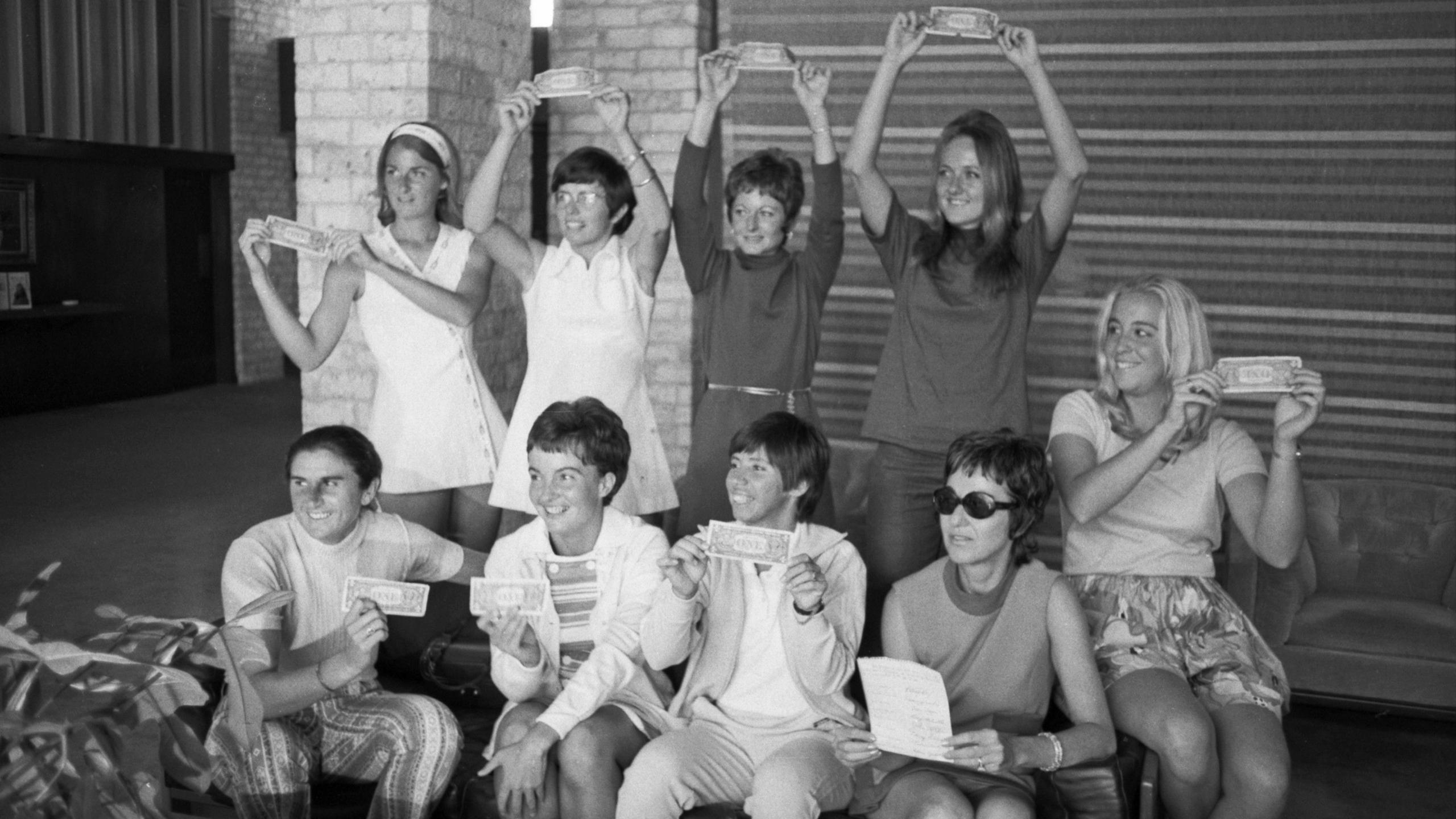
King and eight other women, now known as the ‘Original Nine’, demanded better.

They formed their own women’s circuit, signing a symbolic $1 contract to compete in a tournament in Texas.
They were subsequently banned from competing at the Grand Slams but their bravery paid off. In 1973, they founded the Women’s Tennis Association, a unified body to promote and govern the women’s game.
American showman Riggs had spent much of 1973 giving inflammatory interviews, claiming women «play 25% as good as men, so should get 25% of the money men get» and «if I am to be a chauvinist pig, I want to be the number one pig».
Riggs knew what he was doing in challenging King, a player whose public figure was tied into the ever-growing women’s rights movement. But King knew how symbolic a victory over Riggs would be.
«It represented so much – equality, freedom, equal pay for equal work. I knew I had to win,» King said.
«But I like pressure. I am built for that kind of match.»

A student of the game, King classed Riggs as one of her heroes, and she prepared both physically and mentally for the match.
She watched a replay of his match against Court. At the start, Riggs presented Court with a bouquet of roses. Court curtseyed in response – a move King felt played «right into his hands».
«If that was me, I would have grabbed him and kissed him. If he gets too dirty, I can get tough too,» King told Time magazine in 1973.
Riggs’ preparation was not quite as meticulous. He had gone to Wimbledon earlier that year to watch King play and was not fazed.
«Billie Jean King is one of the all-time tennis greats, but she doesn’t stand a chance against me,» he told Time.
«I’ll psych her out a little bit – she won’t admit it but I can see her coming apart at the seams already…»

King got into the spirit, mocking the way Riggs waddled around court like a duck. But she knew where to draw the line.
Riggs turned up to a practice session wearing a shirt with two circles cut out where his nipples were. He joked that King would look better in it than him.
The next day, in their final news conference, a direct-speaking King called him a creep. Riggs asked her to take it back. King looked him straight in the eye and said: «Creep stands.»
She later told the WTA website: «I knew some people actually did believe some of the sexist things he was spouting, and I wanted to be forceful and clear: it was not OK.»

When matchday arrived, the Astrodome was packed. King’s competitors on the Virginia Slims circuit were in attendance. Those in the premium $100 seats held signs that read «whiskey, women and Riggs» and «who needs women?».
King knew she had a part to play in the pre-match theatre. She entered the arena first on a litter decorated with feathers, carried by four shirtless men dressed as Egyptian slaves.
«The promoter said ‘oh you’re a feminist, you probably won’t get on this Egyptian litter’,» King told Sporting Witness.
«I said ‘are you kidding? What does being a feminist have to do with it? We love entertainment. Pick me up and we go!'»

Riggs followed on a rickshaw pulled by women wearing «Sugar Daddy» t-shirts – the name of a candy company.
The pair exchanged gifts. Riggs gave King a giant lollipop with Sugar Daddy written on it. King handed over a piglet – a reference to Riggs’ reputation as a «male chauvinist pig».
«I called it Robert Larimore Riggs, which is his real name,» King said.
«I said [to the promoter], you have to make me one promise, you can’t kill the piglet – you cannot use it for bacon or pork, you’ve got to leave it on a farm, and they did.»

Unlike the Sabalenka and Kyrgios match, there were no adjustments made. King and Riggs would play five sets – which only the men do at the majors – on a standard court.
In such a boisterous environment, the first set would be crucial. No matter how innately talented Riggs was, he was still a 55-year-old who had not played competitively in years.
But it was King who went an early break down.
«I felt the first set was going to be major, psychologically, to him, so I had to win it. I was playing horribly, making mistakes, and I was giving it to him, basically,» King said.
«Then I said ‘this is my moment of truth, this could mean the difference of winning or losing if you don’t win this set’.»
From 3-2 down, King broke back. At 5-4 down, and with King having set point on the Riggs serve, the American, who claimed the day before he had «no nerves», double-faulted. The set went to King.
«That was major. Psychologically for Bobby, that really hurt him. When we changed ends I could tell he couldn’t believe he lost the first set,» King said.

A naturally aggressive player, King changed tactics against Riggs. She dictated play from the baseline, forcing Riggs to run from corner to corner and tiring him. One report said that of the 109 points she won, 70 of them were outright winners.
King, leading 6-3 6-4, missed her first two match points. But again, Riggs, now serving to stay in the match, faltered. A double fault at deuce when 5-3 down gave King a third match point – and Riggs sent a volley into the net to confirm her victory.
King threw her arms into the air in celebration, before embracing Riggs at the net. As she lifted the trophy King knew she had stood up for women’s sport and won.
«Winning is always a relief. I was so happy it was over,» King said.
«That tennis court is my stage, and you share it with everybody and you want to give it the best show, but this had a lot riding on it.
«I had been living for that moment for a long time.»

In the immediate aftermath, Riggs said he had underestimated King. «Whenever I thought I had the point won on our exchanges, she saved it,» he said.
Later, there were allegations that Riggs had deliberately thrown the match to pay off his gambling debts to the Mafia.
Whatever the circumstances, King’s victory has stuck in the public mind. Not a day goes by when someone does not mention the Battle of the Sexes to her.
«When I met President Obama in the Oval Office for the first time, he said ‘I watched that match when I was 12. I have two daughters now and it made a difference in how I raise them’,» King said.
«The women who saw it, it empowered them and gave them self-confidence.
«And the men come up to me and they’re the ones who are very emotional – sometimes they have tears in their eyes.»
King and Riggs, who died in October 1995, stayed in touch afterwards, and he remained a sporting hero to her.
«We stayed in touch and the night before he died, I had a great discussion with him,» King said.
«He finally understood it was about history. I used to say to him it was about history, and he said no, it was about money.
«He told me he loved me and the next day, he passed away.»
King ended her career with 39 Grand Slam titles across singles, doubles and mixed doubles.
But she is remembered just as much for her fight for equality in sport, and beating Riggs was a crucial part of that.
Sabalenka v Kyrgios in ‘Battle of the Sexes’
Sunday, 28 December from 15:45 GMT
Related topics
- Tennis