
Good luck to NFL officials trying to explain both of these calls.
On Saturday, NFL officials deemed that Bills receiver Brandin Cooks didn’t make a football move after a would-be catch. And despite Cooks’ knee touching the ground with the ball clearly in his possession, Broncos cornerback Ja’Quan McMillian was awarded an interception for stripping the ball away after the two tumbled to the ground.
Advertisement
The call of an interception swung the outcome of Denver’s 33-30 playoff win over Buffalo in the Broncos’ favor.
Why was Davante Adams awarded with a catch?
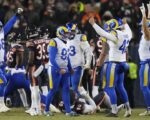
On Sunday, during another critical juncture in a divisional playoff game, Rams receiver Davante Adams was involved in a similar play. Except in this instance, officials awarded Adams a catch.
The catch set up the Rams for a go-ahead fourth-quarter touchdown en route to a 20-17 overtime win.
On the play in question, Rams quarterback Matthew Stafford looked to Adams in traffic over the middle on second-and-10. Adams secured the ball between two defenders.
Advertisement
Before taking a step, Adams was dragged to the ground. Before and as his knee touched the ground, Bears defensive back Tyrique Stevenson had his hand on the ball and was wrestling for control. Stevenson stripped the ball from Adams’ grasp before Adams fell to the turf and took possession of it.
So what made that a catch? Here’s Shawn Hochuli’s explanation on the field:
«The ruling on the field is the runner down by contact,» Hochuli said. «It’s first down, offense.»
Terry McAulay agrees with both calls
The Bears didn’t challenge the call, and the Rams scored a touchdown five plays later for a 17-10 lead. After the catch, NBC cut to former NFL official and rules analyst Terry McAluay for his thoughts. He agreed with his former colleagues that the play was «clearly» a legal catch.
Advertisement
«He clearly completed the catch on this one,» McAulay said. «He has it long enough to perform an act common to the game, and then he goes to the ground, and his knee goes down prior to him losing control.»
Contrast that with McAulay’s explanation on social media Saturday as to why Cooks didn’t catch the ball:
«A player going to the ground to catch a pass must maintain control during and after contact with the ground. That’s the rule. Apply accordingly.»
A player going to the ground to catch a pass must maintain control during and after contact with the ground.
That’s the rule. Apply accordingly.
— Terry McAulay (@tjmcaulay) January 18, 2026
So what’s the difference? Here’s the contested Broncos-Bills play:
McAulay saw an «act common to the game» from Adams that he did not see from Cooks. Adams didn’t take a step. He didn’t turn upfield. He did land upright with both feet on the ground, where as Cooks’ feet touched the ground, but he fell to the turf as he caught — errr, didn’t catch the ball.
Advertisement
That was enough for McAulay to agree with the calls on Adams’ catch — and Cooks’ non-catch.
‘Simultaneous possession’ explanation
CBS rules analyst Gene Steratore was on the call for the Cooks-McMillian play. He also agreed with the call on the field. He wasn’t convinced that Cooks ever had possession of the ball to warrant simultaneous possession, even though Cooks had it firmly and clearly in his grasp as he hit the ground.
«I’m not sure Cooks has possession coming to the ground there, to say that it would be simultaneous» Steratore said. «It feels to me like Cooks didn’t have firm possession of the football when they’re down by contact there.»
Advertisement
More NFL news


Meanwhile, here’s NFL rulebook language that dictates that the ball belongs to the offense in the case of simultaneous possession between a receiver and a defender:
«If a pass is caught simultaneously by two eligible opponents, and both players retain it, the ball belongs to the passers.
«It is not a simultaneous catch if a player gains control first and an opponent subsequently gains joint control.»
Cooks had control of the ball before McMillian stripped it away — rather than the two gaining possession at the same time — which appears to be enough to rule out «simultaneous possession» by the letter of the law.
Are these explanations sufficient?
These explanations attempt to address what is or isn’t a catch. None of them directly address precisely what’s supposed to happen when an offensive player secures a pass that’s dislodged after his knee hits the ground but doesn’t fall incomplete.
Advertisement
In neither of these cases did the ball hit the ground. Somebody had to be awarded possession. And officials are left to make the determination with the rules they have available.
The explanations aren’t likely going to be enough to satisfy those who disagree with either call or both — especially those who see an inconsistency in how the two were called. That the calls were attached to such high stakes on back-to-back nights raises the temperature that much higher.