

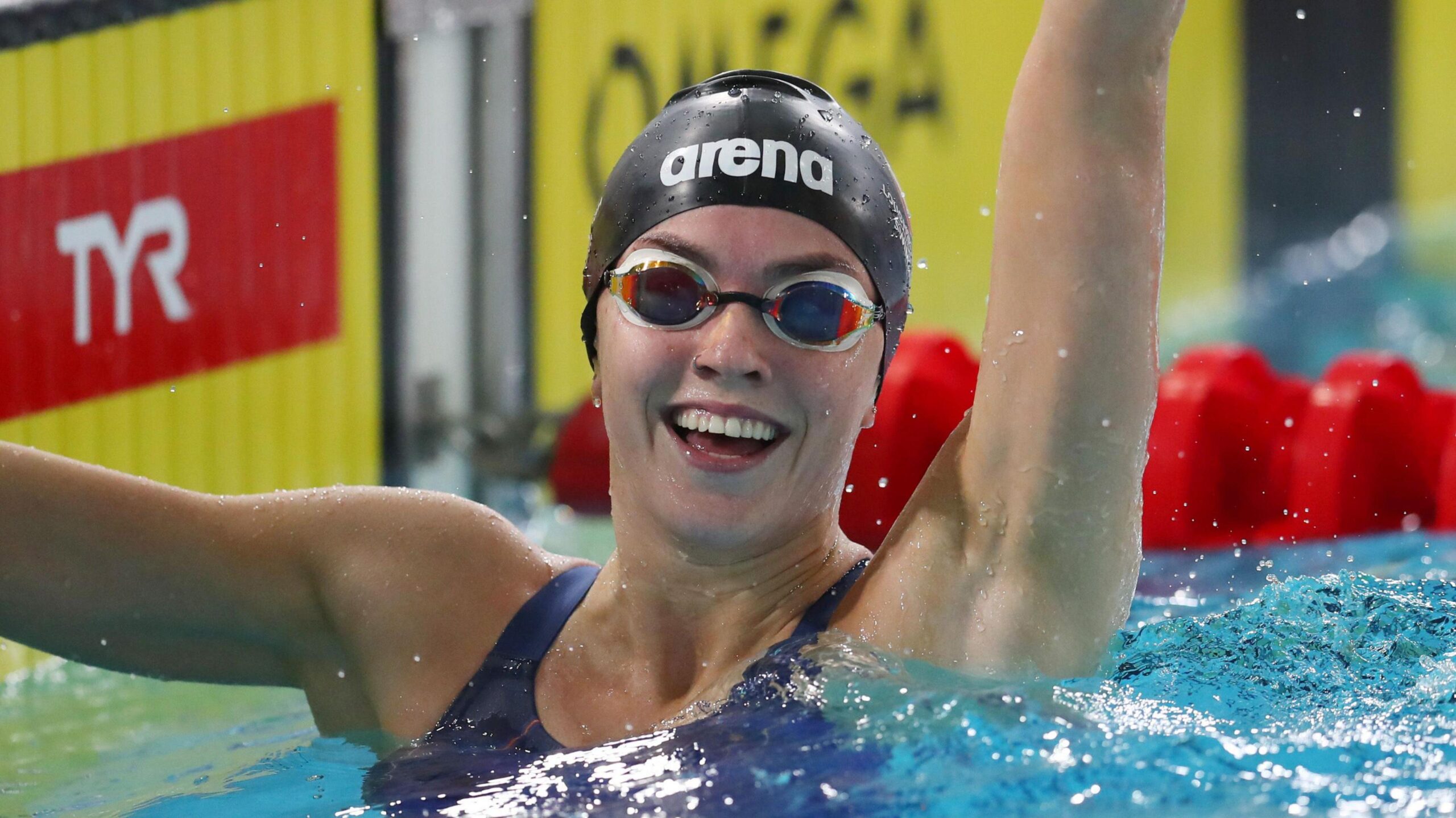

Swimmer Emily Barclay has been named as the latest British athlete to join the controversial Enhanced Games.
The 28-year-old won a gold medal in the 50m freestyle at the 2019 British Championships, before competing for the University of Arkansas in the United States.
Two other British athletes – sprinter Reece Prescod and fellow Olympian swimmer Ben Proud – have already signed up for the event, which allows participants to take performance-enhancing drugs that are banned in mainstream sport.
Its inaugural competition is scheduled to take place in Las Vegas in May.
Barclay is one of three swimmers included in the latest group of athletes announced by the Enhanced Games, alongside two Olympians – Bulgarian Antani Ivanov and Mexican Miguel de Lara Ojeda.
Two female sprinters – Jasmine Abrams of Guyana and Denae McFarlane of Jamaica – are also included.
«As our athletes move through medical review we continue to add elite competitors from across the globe,» said Rick Adams, Enhanced’s chief sporting officer.
«Consistent with previous announcements, this group of athletes appreciates our flexible model that provides them with unmatched and sustained medical supervision, training, nutrition, recovery and financial support. We’re delighted to have Antani, Denae, Emily, Jasmine and Miguel in our inaugural swimming and sprinting fields.»
Last year, World Aquatics became the first international sport federation to ban athletes, coaches and officials from its events if they have taken part in the Enhanced Games.
-
UKA chief ‘appalled’ as Prescod joins Enhanced Games
-
7 January
-
-
Olympic medallist becomes first Briton to join Enhanced Games
-
10 September 2025
-
-
What are the Enhanced Games and why are they controversial?
-
10 September 2025
-
What are the Enhanced Games?
The Enhanced Games launched as a concept in 2023, with some doping measures permitted under medical supervision.
Only substances approved by the United States’ Food and Drug Administration (FDA) can be taken, which is different to the list the World Anti-Doping Agency (Wada) allows for elite athletes.
Organisers have claimed the event «will deliver transparency and health safety by removing the stigma of enhancement – bringing its responsible usage into the light, within an approved medical framework, and one that protects athletes who would otherwise risk their health by operating in the dark to circumvent punitive structures in place today».
However, the event has been criticised for endangering athletes’ health and undermining fair play, with Wada describing it as a «dangerous and irresponsible project» and Travis Tygart, chief executive of the US Anti-Doping Agency, calling it a «clown show».
Earlier this month, UK Athletics (UKA) said it did not recognise the Enhanced Games as a «legitimate sporting competition».
UKA said it «places athletes’ health and welfare at serious risk», adding that «any event that promotes or permits the use of harmful substances with the aim of pushing the human body to its limit for short-term goals is not sport as we value it».
The Enhanced Games are planned to be an annual competition, initially comprising short-distance swimming, sprinting and weightlifting, with the inaugural event set to be held in Las Vegas on 24 May 2026.
The event offers appearance fees and bonuses, with Greek swimmer Kristian Gkolomeev receiving a prize of $1m (£739,000) for beating a world record time in the US in February 2025.
Organisers said he swam 20.89 seconds in a 50m freestyle time trial, 0.02 seconds quicker than the world record set by Brazil’s Cesar Cielo in December 2009, although the time will not be recognised by World Aquatics.
Related topics
- Swimming