


-
-
35 Comments
Formula 1’s brave new world starts this week, when 10 of the 11 teams take part in a private test at Spain’s Circuit de Barcelona-Catalunya.
It is the first of three tests that will be held before the start of the season at the Australian Grand Prix in Melbourne on 6-8 March.
The fact that there are three times as many test days as before last season is a reflection of the size of the change the sport is undertaking this season.
Literally everything about the cars is new – chassis, engines, tyres and fuel make for the biggest regulation change the sport has ever seen.
And this week’s test is private because the teams were concerned about the amount of work required to prepare their cars, and how it might look if they encountered major reliability problems.
Teams are allowed to run on a maximum of three days of their choosing out of the five for which the circuit has been booked.
There will be two further tests, both in Bahrain, on 11-13 and 18-20 February, before Australia. Only the final one will be fully televised live. Highlights will be available to television broadcasters from the first.
Why is the test behind closed doors?
Commercial rights holder F1 and governing body the FIA had been planning to double the amount of testing from the one three-day test that was held in 2025.
But the teams decided they needed more time. So they bandied together, booked Barcelona and have forbidden access to all independent media to ensure their privacy.
That way the teams control the message as well as they can. F1 will have a small television crew on hand to do a limited amount of interviews, and the teams will release approved information.
Doubtless there will be people trying to peek in from outside, but there will be no prying eyes inside the circuit.
Whether this was necessary is a matter of opinion. In 2014, the last time the engine rules changed, all testing was public.
But it was the problems that some encountered that year – Red Bull and Renault were able to do only very limited mileage because of poor reliability – that informed this decision.
-
Horner part of group interested in Alpine stake
-
14 hours ago
-
-
Cadillac ‘here to do great things’, says Perez
-
23 hours ago
-
What’s changing?
The teams’ concerns are founded in trying to make sure their cars work properly having been completely changed between last year and this.
The engines now have a much greater proportion of their total power output provided by the electrical part of the engine – the split is about 50-50.
But the architecture of the power-unit has been simplified, with the removal of one of the devices that recovers energy, the complex and expensive MGU-H, which recovered energy from the turbo and exhaust.
The combination of the requirement to recover more energy, and a more powerful hybrid system, with a battery of a similar size to last year, means energy management will be a central part of F1 in 2026.
As McLaren’s technical director of performance Mark Temple says: «We have a similar capacity battery but you have a higher level of power. So you can use that more on a single straight, get a bigger boost in that one straight from that extra battery capacity.
«But then maybe your [battery] pack is empty. If you press your boost mode and you choose to use all of the energy, you’ll then go into the next corner and come out of it with only what you were able to recover in that corner. That could then leave you exposed in a following straight, which maybe traditionally wouldn’t be such an opportunity.»
The engines will work very differently from before. For example, the internal combustion engine is being used as a charger for the battery much more so than before, which will mean engines will be revving through most corners so the electrical motors can recover energy.
The drivers, too, will be learning fast through these test days. Much of the energy management will be controlled by on-board computers, but there will be a crucial amount left to the drivers to use in racing and for optimum lap time.
The early word is that the drivers who have most spare mental capacity when driving – the likes of Max Verstappen and Fernando Alonso, for example – will have an advantage as a result.
-
Active aero and overtake mode – F1’s new terminology
-
17 December 2025
-
-
Biggest rule change ever and Brit teen – what’s new in F1 in 2026?
-
10 December 2025
-
F1 decided not to allow teams to recover energy from the front axle, only the rear. So to help recover sufficient energy, they have created moveable front and rear wings, to reduce drag on the straights, to ensure the cars are braking for longer.
This has meant the removal of the DRS overtaking aid – because the rear wing is opening for a different reason. It will be replaced by an extra boost of electrical energy if a car is within one second of another, the so-called overtake mode.
Ensuring all these systems work, and beginning work on optimising energy-usage strategies, will be the focus of this first test.
As well as new engines, the rules for the first time mandate fully sustainable fuels, which are carbon-neutral and made from either waste biomass or synthetic industrial processes, or both.
In theory, these are ‘drop-in’ fuels that are a straight replacement for petrol. But in reality they behave differently because of the number of elements they comprise, which has required revised combustion systems to ensure the fuel burns cleanly.
Teams will also be getting to grips with cars whose aerodynamics have changed fundamentally from last year.
The cars are slightly smaller, lighter and narrower, as are the tyres. And in addition to the moveable wings, the entire philosophy behind the chassis rules has changed.
Gone are the underbody venturi tunnels that created ground effect that required the cars to be run as close to the ground as possible with super-stiff suspension.
In their place, F1 has the return of what are known as step-plane floors, essentially flat bottoms similar to those run from 1983 to 2021.
This means the aerodynamics will work in a completely different way, and the cars will behave and need to be driven differently, as a consequence. It is also likely to mean the return of rake – the rear running at a significantly higher ride-height than the front, as was the case until the end of 2021 – and slightly softer springs.
How are the teams getting on so far?

The teams have approached preparations for the new season differently.
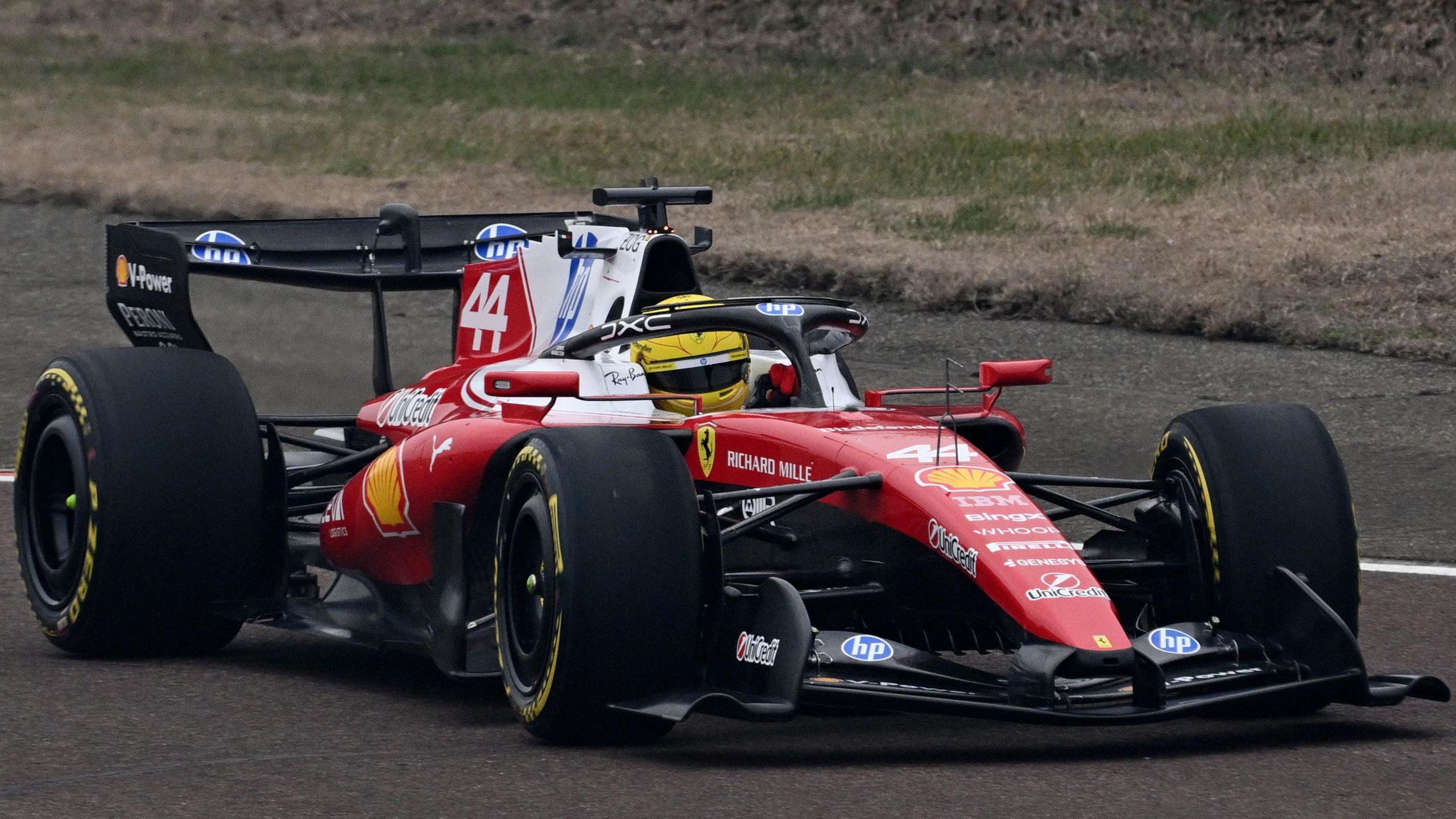
Mercedes, Ferrari, Racing Bulls, Haas, Alpine and the new Audi and Cadillac teams have all run their cars already in short tests.
World champions McLaren will not start running until at least the second day of the Barcelona test, and possibly not until Wednesday, a decision made to maximise development time.
Red Bull and Aston Martin have also not run their cars, and have not yet revealed their Barcelona programme.
And while Williams intended to be in Barcelona, they have suffered delays to their car-build programme, and last week made the decision to skip the test altogether, saying that was the best compromise for «a better engineering outcome».
There are also differences in approach to early-season development.
Ferrari have said they are running a basic version of their car in Barcelona, to ensure it all works, and then will add developments for the start of the season.
McLaren, meanwhile, say their car will change little between Barcelona and the first race, a reflection of their approach to leaving design as late as possible.
In theory, that also gives them the chance to take stock in the early weeks of running, leaving more development resource to react if it becomes clear that one team has hit on the best way of approaching the rules.
Despite the secrecy, snippets of information are likely to slip out of Barcelona as the week progresses – that’s just the way F1 is.
But even if they do, with the long build-up to this season and the fact that development curves are always steep when new rules are introduced, it will take some considerable time before the shape of the season really comes into focus.
Related topics
- Formula 1
-
Back At Base S3: 1. All at Risk