

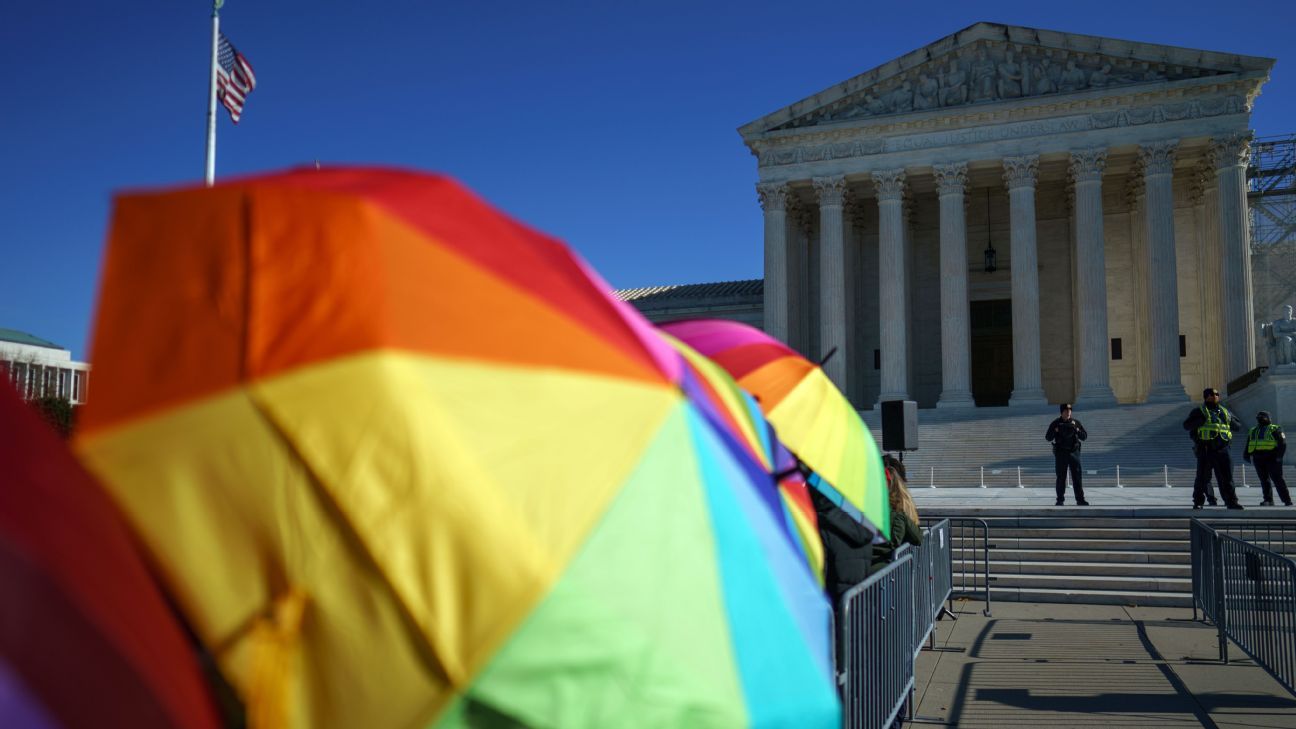
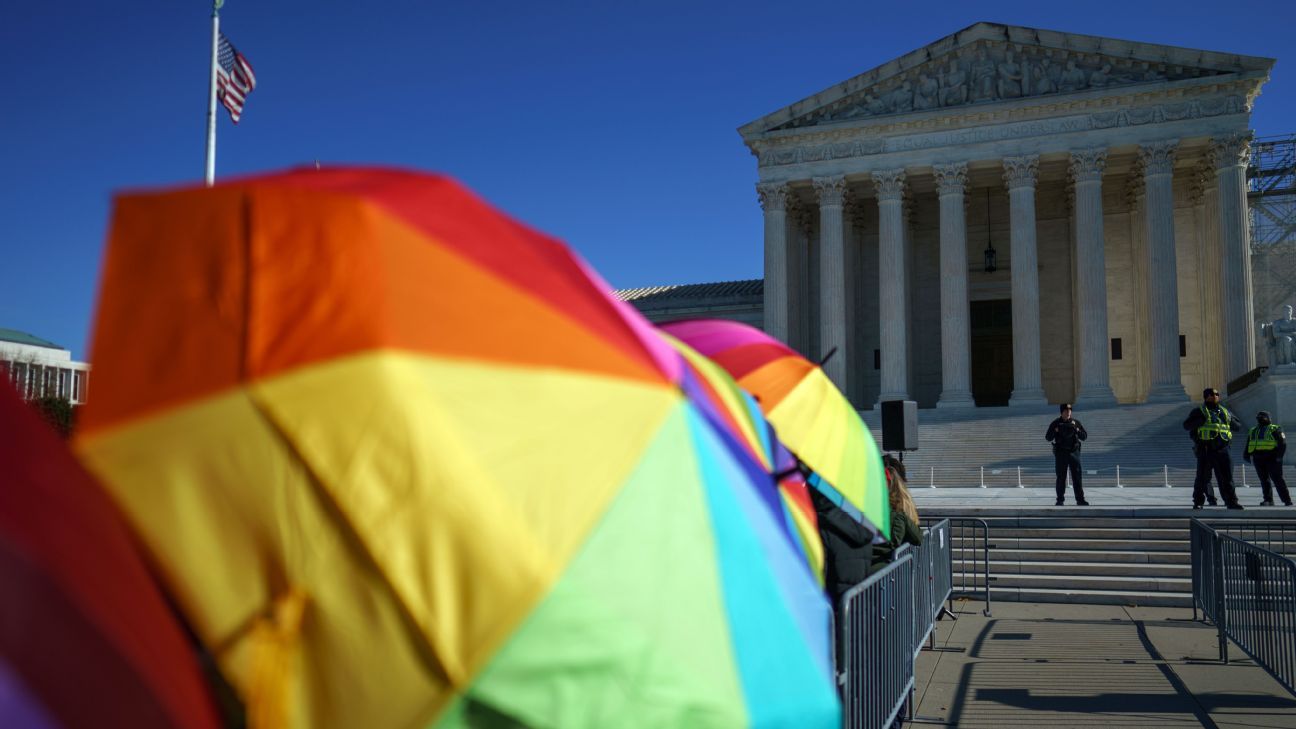
The U.S. Supreme Court will hear oral arguments in two cases pertaining to transgender athletes on Tuesday: Little v. Hecox and West Virginia v. B.P.J. The cases bring the national debate over whether transgender girls and women should be eligible to compete in girls’ and women’s sports to the country’s highest court.
Little v. Hecox is a dispute over the first state law, Idaho’s HB 500, that barred transgender girls and women from girls’ and women’s school and college sports. Gov. Brad Little signed the bill into law in March 2020, and Lindsay Hecox, a transgender woman, challenged it weeks later because she wanted to try out for Boise State’s women’s track and cross country teams. A U.S. district court in Idaho granted Hecox an injunction, and she tried out for the Broncos’ cross country team, but she did not make it. Hecox instead participated in women’s club soccer and running, which are also affected by HB 500. After a series of appeals by the state, the Supreme Court agreed last July to hear the case. Hecox’s attorneys argue, in part, that the Idaho law violates the equal protection clause of the 14th Amendment to the Constitution.
Similarly, West Virginia v. B.P.J. puts West Virginia’s HB 3293, one of 27 state laws that restrict transgender girls and women from sports, in front of the Supreme Court. Becky Pepper-Jackson, a 15-year-old transgender girl, was entering middle school when the law passed in April 2021. Pepper-Jackson wanted to compete on her school’s sports teams, but her school principal told the family the state law prevented her participation. Pepper-Jackson and her family challenged West Virginia’s law the summer before she began middle school, and she has since been allowed to participate in cross country and track and field. Pepper-Jackson’s attorneys argue, in part, that her right to compete on the girls’ teams is guaranteed by Title IX because her gender identity matches the category and she has undergone an estrogen-driven puberty. West Virginia argues, in part, that her participation on girls’ teams violates Title IX because her birth sex is not female. Last July, the Supreme Court agreed to hear the case.
The athletes will not testify during Tuesday’s oral arguments. Their lawyers will present their cases to the court on their behalf. Likewise, attorneys for Little and West Virginia will represent their side of the debate.
Here’s what you need to know about the cases before the Supreme Court hears oral arguments.
What’s at stake?
In simple terms: The future of transgender girls and women in girls’ and women’s sports.
Since Idaho passed HB 500, 26 other states have passed laws restricting access to girls’ and women’s sports for transgender students in schools and universities that receive public funds. In the past few years, a number of international federations have enacted similarly restrictive policies: World Aquatics (swimming, diving and water polo) allows only transgender women who never experienced testosterone-driven puberty to compete in the women’s category at elite events such as the world championships, and World Athletics (track and field and road running) bans all transgender women in the women’s category.
In the United States, President Donald Trump signed an executive order on Feb. 5, 2025, that said schools and states that allow transgender girls and women to participate in girls’ and women’s school sports are in violation of Title IX and risk federal funding. That led the NCAA to change its policy to align with the executive order. Additionally, United States Olympic and Paralympic Committee CEO Sarah Hirshland and president and chair Gene Sykes directed national governing bodies to update their transgender policies to «comply with federal expectations.» Many organizations under the USOPC have implemented new policies, and some impact youth sports opportunities.
When and how did the legal landscape change regarding transgender athlete participation?
Idaho state legislator Barbara Ehardt said she was inspired to write HB 500 after two transgender athletes won high school track and field state titles in Connecticut in 2018.
«It’s not just a bill that I sponsored, the entire idea was mine, and that’s why it took two years to finally come to pass,» Ehardt said. «And then each year to see so many states take it up and pass it … it has been a unique experience, and it’s been an incredibly gratifying one.»
Since HB 500 was signed into law in 2020, the debate over transgender participation made national news after former Penn student-athlete Lia Thomas, a transgender woman, won an NCAA Division I swimming national championship in 2022. The issue returned to the headlines after Blaire Fleming, also a transgender woman, played on San Jose State’s women’s volleyball team. Multiple teams in the Mountain West Conference chose to forfeit rather than play against SJSU in 2024, and SJSU captain Brooke Slusser joined a lawsuit against the NCAA, arguing that Fleming’s participation on the SJSU volleyball team posed a safety risk and violated Title IX.
What do the Idaho and West Virginia laws say about sports participation for transgender students?
Idaho’s HB 500 and West Virginia’s HB 3293 are not identical, but they do similar things. Both laws identify «interscholastic, intercollegiate, intramural, or club athletic teams» as the range of activities to which the restrictions for transgender athletes apply. Both laws establish three categories for sports: female, male and co-ed, and both laws restrict access to the female category by closing it to students defined as male. HB 3293 (West Virginia) defines biological sex as determined by an «individual’s reproductive biology and genetics at birth.» HB 500 (Idaho) does not formally define biological sex but says in the case of a dispute, a student can establish biological sex through physical exam and statement from their healthcare provider that bases their findings on at least one of these factors: «the student’s reproductive anatomy, genetic makeup, or normal endogenously produced testosterone levels.»
Why is the Supreme Court hearing two cases?
It’s not uncommon for the court to hear multiple cases that present similar, if not the same, legal questions, especially on a controversial or large issue.
«There are many other examples of when a big issue is up at the court, they will take two cases,» said ACLU senior counsel Joshua Block, who will present oral arguments for B.P.J. at the Supreme Court. «Another reason to do that is if they’re worried about a jurisdictional problem coming up in one of the cases that they have another one to go to.»
One possible issue that could arise on Tuesday is that Hecox asked the Supreme Court not to decide her case at all. She is no longer participating in sports in Idaho and therefore contends her case is «moot.» Idaho contends the case is not moot because the state and Boise State University still have an interest in enforcing HB 500.
Which federal laws and constitutional questions will be in play?
The primary questions are about Title IX and the equal protection clause of the 14th Amendment to the Constitution.
What is Title IX and how does it apply to transgender people?
Title IX was passed by Congress in 1972 and bars sex-based discrimination in schools receiving federal funds, including in school-sponsored programs and activities. It is largely credited with creating and expanding girls’ and women’s sports programs, but it applies to schools broadly. The law is 37 words, but in 1975, Congress approved regulations for Title IX’s application. Enforcement power belongs to the Department of Education.
Title IX does not say anything about transgender students or transgender athletes. But in May 2016, the Obama administration issued guidance stating Title IX applied to transgender students and that to be compliant with the law, transgender students should be allowed to access bathrooms, locker rooms and sports teams in accordance with their gender identities. This guidance never fully went into effect because multiple state governments sued the Obama administration. The first Trump administration rescinded that guidance, and then the Biden administration moved to expand transgender students’ rights, but the policy got tied up in court. The second Trump administration has issued multiple executive orders that roll back governmental recognition of transgender people in sports and beyond.
live audio starting at 10 a.m. ET and releases transcripts at the end of the day. The court will hear Little v. Hecox in the morning session. West Virginia v. B.P.J. is scheduled to begin at 1 p.m. ESPN will provide live updates from inside and outside the Supreme Court throughout the day,
What happens next?
After the cases are argued, the court will deliberate and publish an opinion, or opinions. The possible outcomes range from procedural dismissals, to narrow rulings, to landscape-altering orders. The decision’s timing is unknown. Opinions are generally published during non-argument sessions. According to the Supreme Court’s public calendar, the first non-argument session after oral arguments will be Feb. 20. There is one non-argument session in March, another in April, three in May and four in June. This is subject to change as the term continues, and more opinion days could be added.