

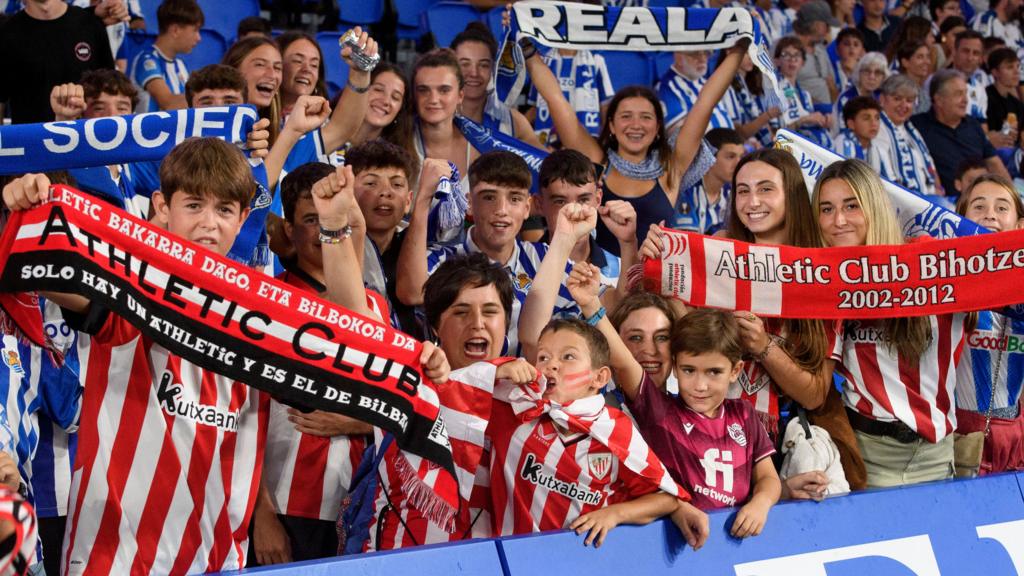
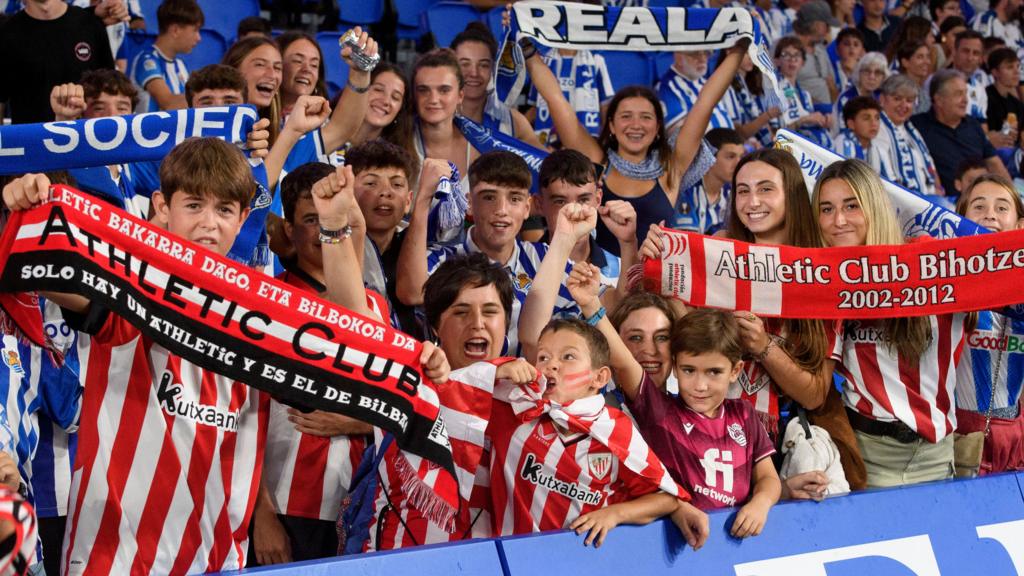
The Basque derby between Athletic Club, based in Bilbao and Real Sociedad, based in San Sebastian, is unlike almost any other rivalry in world football.
Competitive yet respectful, friendly yet fierce, it’s a rivalry that’s not defined by hostility but by a shared identity that transcends the colours worn on match day.
For fans on both sides, this is not just another fixture. It is a celebration of football, culture, and a shared Basque identity. With the two clubs around 60 miles apart on the north-west coast of Spain, rivalry exists, but never at the expense of respect.
This Sunday’s match takes place at San Mames stadium (20:00 GMT), home to Athletic Club, who were beaten 3-2 in November’s reverse at Sociedad.
Real Sociedad are currently eighth in La Liga with 27 points, three points ahead of 13th-placed Athletic Club.
So, why is this derby different?
«It’s the joyful and friendly relationship among fans that makes it so special», says Gaizka Atxa, an Athletic Club fan and founder of the UK supporters group.
«Although there is a fierce rivalry, the two clubs and their fans treat it with a high level of sportsmanship. We respect each other and have a jolly good time with some fun banter.»
What truly sets this derby apart is what happens off the pitch.
Before kick-off, fans from both teams gather for what’s known in Basque as poteo, traditional pub crawls through the streets of Bilbao or San Sebastian, sharing drinks, laughter, and songs.
«In the stadium, we can all mix and sit together without a problem,» Atxa adds. «That’s something very special.»
Food and drink are central to the experience. As Atxa puts it, «We Basques love to eat and drink, and the derby is the perfect excuse to enjoy a good feast among friends before going to the pitch.»
The derby is one of the most important dates on the calendar for Aitor Salinas-Armendariz, another Athletic supporter.
«Having so many away fans in the stands who are often friends and relatives is something unusual in the rest of La Liga,» he explains.
«It’s totally normal to see away fans in the seats in the home stands. They’ll probably have been given the ticket by a home fan’s relative.»
Both sets of supporters see themselves as part of the same Basque community. This shared identity shapes the atmosphere surrounding the derby.
«There is a strong sense of belonging,» Salinas-Armendariz explains. «We feel part of the same community, with common claims and struggles that go beyond what divides us.»
That sense of unity is visible everywhere on match day. Fans sharing the same bars, enjoying the pre-match build-up, and watching the match together.
It’s «a colourful and festive derby» Edu, a Real Sociedad supporter explains.
«Although Athletic has more titles, always drawing on the past, we treat each other as equals,» he says. «In the same group of friends, there are often both Real and Athletic fans. It’s a rivalry between brothers.
«We tease each other, banter a lot, and end up hugging.»
This is the «defining rivalry of Basque football», according to Athletic Club journalist Benat Gutierrez Parro.
«Although other Basque derbies share some characteristics, none is as intense as Athletic–Real Sociedad,» he says.
The rivalry reflects not only football competition but also the historic relationship between Bilbao and San Sebastian.
Given they are geographically close, the clubs frequently compete for the same talent, a tension heightened by Athletic’s policy of only signing Basque players.
«These are matches where both sides have many players who came up through their youth academies and know exactly what it means to beat one of your biggest rivals», Gutierrez Parro said.
«Many have also grown up as fans of the teams they are now defending, which means that the level of passion on the pitch is usually high.»
Form, league position, and momentum matter less when pride is at stake.
«The derby always evens the playing field,» Gutierrez Parro says. «It’s not just three points, it can shape the next phase of the season for both teams.»
Despite the intensity, trouble between fans is virtually non-existent.
Sara, a Real Sociedad fan, sums it up simply: «There’s rivalry, but usually with respect. The atmosphere is different from other derbies, people from both teams get together, and there are normally no problems.»
A distinctive feature of derby day is an organised cultural event known as the Bertso Derbia.
Jointly organised by the foundations of both clubs, the event brings together Basque improvisational poets, known as bertsolaris, who compose and perform verses in Euskara, the Basque language.
The performances touch on football rivalry, social issues and local identity, delivered with humour and sharp wit as each side attempts to outdo the other.
A moderator ultimately decides which team has won the competition
The event brings the two teams together and fosters a healthy rivalry between the clubs, according to Athletic Club communities director Johana Ruiz-Olabuenaga.
«It’s really nice because it’s a combination of fun, identity, culture, and it’s football at the same time,» she says. «It’s a family event for everyone and is a great part of the day.»
Perhaps that is why it has earned its reputation as the friendliest derby in the world.