

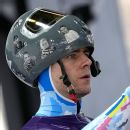
CORTINA D’AMPEZZO, Italy — Ukrainian skeleton athlete Vladyslav Heraskevych will not compete at the Milan Cortina Games on Thursday after refusing a last-minute plea from the International Olympic Committee to use a helmet other than the one that honors more than 20 of his country’s athletes and coaches killed in the war with Russia.
The decision came roughly 45 minutes before the start of the competition, ending a three-day saga where Heraskevych knew he was risking being pulled from the Games by wearing the helmet, one that the IOC says goes against rules against making statements on the field of play.
He received written word Thursday from the International Bobsled and Skeleton Federation, which said his decision to wear the helmet was «inconsistent with the Olympic Charter and Guidelines on Athlete Expression.» He wore the helmet in training, but the IOC had asked him to wear a different helmet in races and offered concessions such as the right to wear a black armband or the ability to display the helmet once he was off the ice.
«I believe, deeply, the IBSF and IOC understand that I’m not violating any rules,» Heraskevych said. «Also, I would say [it’s] painful that it really looks like discrimination because many athletes already were expressing themselves. … They didn’t face the same things. So suddenly just the Ukrainian athlete in this Olympic Games will be disqualified for the helmet.»
IOC president Kirsty Coventry, who was slated to be in Cortina d’Ampezzo on Thursday to see Alpine skiing, went to the sliding center instead to meet Heraskevych. She was waiting at the top of the track when he arrived around 8:15 a.m., and they met privately a few minutes later. After about 10 minutes, Coventry was unable to change Heraskevych’s mind.
«We didn’t find common ground in this regard,» Heraskevych said.


1 Related
After word of Coventry’s emotions, Heraskevych said, «In Ukraine now we also have a lot of tears,» and said the decision «plays along with Russian propaganda.» About a dozen Russian athletes are competing at the Olympics as neutral individuals along with seven Belarusians. They are not allowed to compete under their national flag or anthem.
«Disqualified. I think that’s enough to understand what the modern IOC really is and how it disgraces the idea of the Olympic movement,» Ukrainian skier Kateryna Kotsar wrote on Instagram. «Vladyslav Heraskevych, for us and for the whole world, you’re a champion. Even without starting.»
The IOC had sided with Ukraine’s top slider before. When he displayed a «No war in Ukraine» sign after his fourth and final run at the 2022 Beijing Olympics, the IOC said he was simply calling for peace and did not find him in violation of the Olympic charter.
This time, Heraskevych said he believes there are inconsistencies in how the IOC decides what statements are allowed. Among those he cited: U.S. figure skater Maxim Naumov bringing a photo of his late parents — former pairs world champions Evgenia Shishkova and Vadim Naumov, who were among the 67 people killed in a plane crash on Jan. 29, 2025 — to the kiss-and-cry area after his skate in Milan on Tuesday night, and Israeli skeleton athlete Jared Firestone’s decision to appear at the opening ceremony wearing a kippah that bore the names of 11 Israeli athletes and coaches killed in the 1972 Munich attack.
«A competitor literally placed the memory of the dead on his head to honor them,» Heraskevych wrote on Instagram. «I frankly do not understand how these two cases are fundamentally different.»
Firestone said he admired Heraskevych while noting «the flag on my helmet’s just representing the country.»
«I think he’s a man with strong values. I think it’s very impressive. As a person, I really, really respect him,» Firestone said.
In Milan, IOC spokesman Mark Adams fielded a slew of questions about the case.
«It is simply about the sanctity of the field of play,» he said, insisting the rules also protected athletes in some countries from being pressured by «their political masters» to bring messaging into Olympic arenas.
«You could see where that would lead to a chaotic situation,» Adams said.
Heraskevych was fourth at the world championships last year and was consistently among the fastest in training leading into the Olympic races. A medal was certainly within reach, but to Heraskevych, the helmet mattered more.
«The International Olympic Committee destroyed our dreams,» said Mykhailo Heraskevych, the slider’s coach and father. «It’s not fair.»