


-
-
71 Comments
The final pre-season test confirmed there will be a new Formula 1 when the new season starts in Australia in two weeks’ time.
New in the sense of who is at the front – and new in terms of many aspects of the sport and how it works.
So what did the last three days of running in Bahrain, before the teams decamp to Albert Park in Melbourne, say about the reshaped sport – and who are the winners and losers within that?
A best guess at the competitive order
Ferrari’s Charles Leclerc ended the test with the single fastest lap time in an emphatic way – 0.811 seconds quicker than the next best time, set by Mercedes’ Kimi Antonelli.
Headline times in testing are usually not the place to look to gauge the competitive order, but this did reflect the picture in one important way – Mercedes and Ferrari look like they are going into the new season in the best shape.
Andrea Stella, team principal of world champions McLaren, said on Friday evening: «This test has confirmed that Ferrari and Mercedes look like the teams to beat. McLaren and Red Bull [are] probably very similar, Ferrari and Mercedes a step ahead.»
This picture, an impression reflected by many other senior figures up and down the pit lane, comes less from the headline lap times – even if they did show the teams in the order Ferrari, Mercedes, McLaren, Red Bull – than the so-called race-simulation runs.
Because the teams fill up their cars with fuel and run a grand prix distance, these have far fewer variables to muddy the picture than single laps.
On Friday evening, Leclerc did the best race simulation of the week, slightly quicker than Red Bull’s Max Verstappen and McLaren’s Oscar Piastri the day before, when they set more or less exactly the same time.
Mercedes did not do any race simulations in the second week, only in the first, when track conditions were up to a second slower.
Antonelli set comfortably the fastest race simulation of the first week – a lot faster than Piastri, who was running at the same time.
And his team-mate George Russell – the bookies’ pre-season championship favourite – was also impressively quick when running in the hotter, slower conditions earlier in the day.
This is not an exact science, but the cumulation of data is what led to the conclusion reached by Stella and many others.
A complication was that McLaren were not running the latest specification of Mercedes power-unit, so can expect an uplift when they switch in Australia to the latest spec.
Another is Red Bull’s new engine is said by Russell to have the best deployment of energy, which is such an important facet this season.
Mercedes’ biggest concern is reliability. This hit Antonelli much more than Russell, but it’s probably fair to say that Mercedes suffered more problems than their major rivals, although Red Bull’s new recruit Isack Hadjar did lose a fair bit of his running to issues of one kind or another.
-
Relive final day of pre-season testing as Ferrari’s Leclerc fastest in Bahrain
-
‘Keep calm,’ says Domenicali on criticism of new F1 rules
-
20 hours ago
-
-
Norris admits new F1 cars ‘not purest form of racing’
-
1 day ago
-
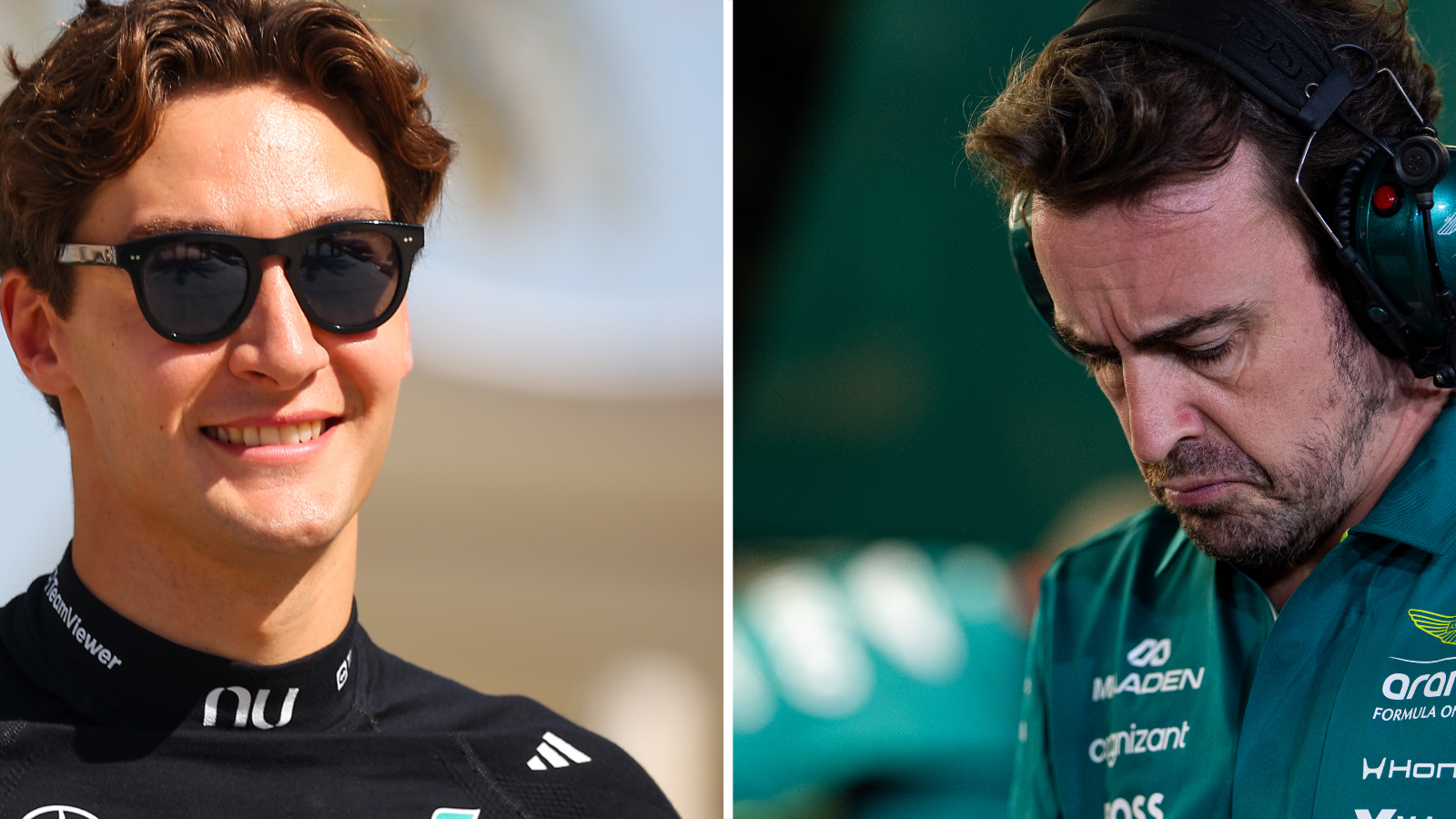
Aston Martin in a world of pain
There is no question as to the prize for biggest disappointment so far this year. Aston Martin, starting their new works partnership with Honda, are runaway winners of that.
With design legend Adrian Newey at the helm, Honda – world champions with Red Bull as recently as 2024 – and the money of their billionaire owner Lawrence Stroll and Saudi Arabia’s Public Investment Fund (PIF), all the ingredients for success seem to be there.
But the new car, delayed by the fact Newey did not arrive until March last year, is uncompetitive and difficult, and the engine is slow and unreliable. Aston Martin completed the fewest laps of testing, and look like they may even be in worse shape than Cadillac.
Both the internal combustion engine and hybrid elements of the new Honda power-unit are said to be well behind the best.
Several sources told BBC Sport this week that Newey said at Wednesday’s meeting of the F1 Commission – a rule-making body comprising all the teams as well as F1 and the FIA – that the Honda could not even recover at the lower limit of 250kw, let alone the higher one of 350kw, which comes into force under certain circumstances in the highly complex rules.
Reliability was so bad that by the start of the final day of the test, Honda had only one battery left, and took the decision to limit running to only short runs. A statement said that was to allow them to study data in between track outings, but in the end Lance Stroll did only six laps all day.
The problems with the engine make it difficult to make any judgement on the car – the Honda is running so badly that it’s hard for the team to work out where the car is, and therefore how to improve it.
This is exacerbated by the fact Aston’s first in-house gearbox – they have bought them in previously – is not communicating with the engine properly, and keeps behaving oddly, making life even more difficult for the drivers.
For Fernando Alonso, this all must come with an agonising sense of deja vu. He spent three painful years at McLaren when Honda were underprepared when they re-entered F1 in 2015.
And now he faces another one, at the age of 44, and with his contract running out at the end of the year.
Publicly, Alonso is staying optimistic as he said: «Short and medium term, I don’t think there is anything that is impossible to fix.»
How long it takes, though, is another matter. And one thing Alonso does not have much of is time.
Alpine on the rise
While all the teams are reluctant to say exactly where they think they stand in the competitive order, all are clear that there appears to be three groups of teams – the top four, the midfield, and then Aston Martin and Cadillac at the back.
Among the midfield runners, who are in the region of at least a second a lap slower than the big four, the team poised to make the biggest step seem to be Alpine.
They finished last season last, by the biggest margin ever, partly because they devoted extremely limited resource to last year’s car, so they could focus on this year.
Alpine have switched to a Mercedes power-unit, following parent company Renault’s decision to end its F1 engine programme. And with the combination of this and a much-improved car appear to have jumped up to the top of the midfield fight.
There is some debate as to whether they or Haas are in the best shape, but either way this is huge progress for the French team.
Racing Bulls are also in this mix at the top of the midfield.

But Williams disappoint
Among the midfield teams, Williams seem to be the biggest losers. Their 2026 car has been a disappointment so far, overweight by a significant margin – said to be anywhere between 25 and 40 kilos – and lacking downforce.
Williams finished fifth last year, and this season was supposed to be the next step in their ambition of a return to the top of F1.
Team principal James Vowles has been saying for two years how much of an opportunity the new rules are to move forward, and was vocal last season as to how early they had switched to the 2026 design and compromised 2025 for exactly this reason.
So this is a major blow.
Audi, which has taken over Sauber for the start of its brand new works programme with its own in-house engine, were expected to have difficulties.
But they appear to be in decent shape and have been quietly impressive in the midfield context, and could well be ahead of Williams, even if a long way from their ultimate ambitions.
Pros and cons of the new cars
The leading drivers have all at various points expressed their dissatisfaction with the new rules, especially the amount of energy management required with the new hybrid power-units.
These feature a near 50-50 split between internal combustion engine and electrical components.
With the amount of hybrid power increased three-fold, a component of the engine that helped recovery energy removed, and the batteries more or less the same size as last year, the cars are energy starved.
This has led to some unusual aspects being added to driving.
These include not going flat out in the run up to the start of a qualifying lap, taking corners in higher gears than is optimum for lap time to keep the turbo spinning, lifting and coasting in qualifying, and even not going flat out at the end of a qualifying lap because it is more time-effective to use the energy elsewhere.
At some circuits, there will be a lot more energy recovery required than others by the various means available. These include recovering while at full throttle, known as «super-clip», and lifting and coasting, as well as the standard method, during braking.
Albert Park is one of these energy-poor circuits.

For a purist, and drivers who want to be on the limit at all times, this is not ideal.
But F1 as a sport has known this was coming ever since the power-unit regulations were created in 2022. And, for now, the drivers are going to have get used to a new normal.
Behind the scenes, meanwhile, there are ongoing discussions as to how to allow the drivers to drive in a more conventional way, but it remains to be seen how these will resolve.
However, having seen the cars on track, and watched them on television, it is highly unlikely the average viewer will notice any difference. They still look like F1 cars, and in some ways are more appealing than last year’s.
They are smaller and have less downforce, so they slide more in corners, and look more agile. Many of the fast corners that were rendered bends in straights by last year’s cars will become a driving challenge again, such as Abbey at Silverstone.
Russell, while acknowledging the differences from previous cars, said: «The guiding principles are still very much the same. You’re pushing the car to the absolute limit. You’re trying to brake as hard and late as possible, and carry as much speed through the corners. So far, I’m quite enjoying it.»
Mercedes set to win engine row
Off track, one of the main focuses of pre-season has been a row between the engine manufacturers over the rules governing the engines’ compression ratio.
It split the engine suppliers into two groups, Mercedes versus the rest – Ferrari, Honda and newcomers Red Bull and Audi.
The row was dismissed earlier this week by Vowles – a Mercedes customer – as «noise that will probably go away», and by Mercedes F1 boss Toto Wolff as «a storm in a teacup».
And it looks like both will end up being right.
Why have Mercedes been targeted? Because their rivals believe they have found a way of exploiting the rule restricting the compression ratio – a measurement of the cylinder displacement between the two extremes of the piston stroke – to 16:1. The rules dictate it is measured at ambient temperature.
Typically, the compression ratio reduces when engines heat up, and the belief was Mercedes had found a way using materials technology to limit this loss.
Mercedes’ rivals have been pushing for a rule that measures it at a higher temperature, in the hope of restricting their perceived advantage.
This could also have allowed the others to set their ambient temperature compression ratio higher than 16:1 so that it was at the limit at a higher temperature, and so improve the performance of their engines relative to Mercedes.
Governing body the FIA has proposed a compromise whereby the ratio is measured both at ambient temperature and 130C.
As this does not achieve the aim Mercedes’ opponents wanted, the signs are the other companies may even vote against the proposal that came out of their own campaign. Even if it passes, it seems it will make no difference.
Wolff added: «The way it works, you know, either we stay with the regulations like we are or the e-vote goes ahead with the proposal that came from the FIA. Both are OK for us.»
Start-line variability

The new engines are also much harder to get off the line, which many expect will lead to unpredictability at starts.
There were safety concerns about this at the start of the first test – especially the risk of a car slow away being rear-ended by another at high speed.
But these were largely assuaged by a new start line procedure that was trialled at the test, which gives the drivers more time to get the turbos spinning at the optimum speed.
On the face of it, the Ferrari-engined cars seemed to have an advantage – they rocketed past rivals on several occasions during these tests.
But Williams driver Alex Albon said: «I don’t think what you’re seeing is really what’s going to happen. You’ve got drivers who are finishing long runs, going into a practice start, on a high-mileage tyre that’s already gone. So you’ve seen this chaos of some people getting good starts, bad starts, but actually it’s not as bad as that.»
And data seen by BBC Sport showed that, actually, of all the starts performed in testing, the Mercedes-engined teams as a bloc had the best starts on average – they were ranked in four of the top five places – followed by Ferrari-powered cars.
Strangely, Racing Bulls were second and Red Bull last, despite having the same Red Bull Powertrains/Ford engine.
Fastest times by team in second pre-season test
-
Ferrari (Charles Leclerc) one minute 31.992 seconds
-
Mercedes (Kimi Antonelli) Mercedes 1:32.803
-
McLaren (Oscar Piastri) 1:32.861
-
Red Bull (Max Verstappen) 1:33.109
-
Alpine (Pierre Gasly) 1:33.421
-
Haas (Oliver Bearman) Haas 1:33.487
-
Audi (Gabriel Bortoleto) 1:33.755
-
Racing Bulls (Arvid Lindblad) 1:34.149
-
Williams (Carlos Sainz) 1:34.342
-
Cadillac (Valtteri Bottas) 1:35.290
-
Aston Martin (Lance Stroll) 1:35.974
Related topics
- Formula 1