

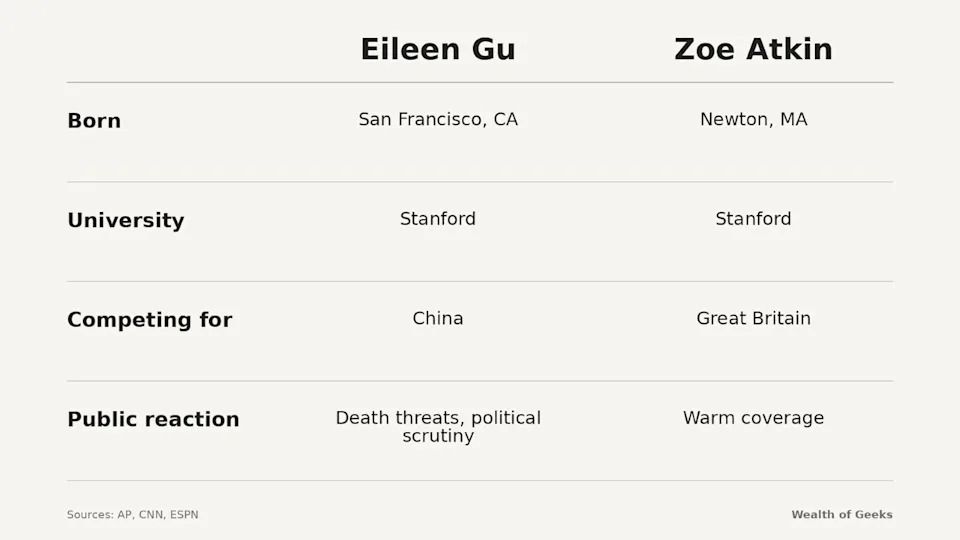
Two young women stood on the halfpipe podium in Livigno last Sunday. Both were born in the United States and attend Stanford. Both chose to compete for a country that isn’t America. One got a bronze medal and a glowing ESPN write-up. The other spent the past two weeks fielding political criticism and online vitriol while competing under the weight of what she described as “two countries on my shoulders.”
The skier who has publicly said she received death threats is Eileen Gu. The one who didn’t is Zoe Atkin. And the gap between those two experiences is the story most coverage is still tiptoeing around.
Advertisement
The Setup Nobody Is Acknowledging

Graphic: Wealth of Geeks
Atkin was born in Newton, Massachusetts. Her father is British, and she has been eligible to represent Great Britain since birth. She has competed for Team GB for years, and America has largely treated it as a human-interest story: talented American-born skier, British passport, end of conversation.
Gu’s situation is messier — not because athletes don’t switch flags, but because of how China handles nationality. China does not recognize dual citizenship. Gu has repeatedly declined to publicly clarify her U.S. citizenship status. There is no public U.S. government record showing she formally renounced it either, a detail noted in prior reporting. The ambiguity has lingered for years, and culture wars thrive on ambiguity.
Advertisement
That distinction is real. It still does not explain the scale of the difference in how America treats these two women.
What America Actually Said

Former NBA player Enes Kanter Freedom’s social media post attacking Gu’s decision to compete for China during the 2026 Winter Games. (Screenshot via New York Post/X)
Gu has described being physically assaulted, having her dorm robbed, and receiving death threats tied to the backlash over representing China. These claims have been widely reported. The criticism has not stayed in the comment section. Vice President JD Vance weighed in during the Games, responding to a question about her choice in a way that kept the controversy in the political arena. Former NBA player Enes Kanter Freedom attacked her decision. Online, the argument often skips past sports entirely and goes straight to loyalty language: traitor, betrayal, pick a side.
Advertisement
Atkin’s reception has been the opposite. Warm coverage. Celebration. A medal story that gets to remain a medal story.
The Variable Nobody Wants To Name
The variable that best explains the gap is not citizenship paperwork. It’s China.

Citizenship can be technical. The reaction rarely is. Credit: Annie M (@alexa_filmvibes) via Unsplash.
Gu said it plainly during the Games: people “lump China into this monolithic entity” and “just hate China,” she argued, adding that the outrage is less about her personal decision than what the flag represents. She has also suggested that winning intensifies the reaction.
That part matters. Flag-switching isn’t the issue. China is. And so is the fact that Gu wins.
The Counter-Argument, Stated Honestly
There is a coherent response to all of this: Great Britain and China are not equivalent choices. One is a close democratic ally. The other is a geopolitical rival with a documented human rights record and state-sponsored sports programs that have drawn scrutiny. Recent reporting also detailed financial support Gu received from Beijing’s municipal sports bureau in prior years, which became part of the broader political debate.
Advertisement
It is not, however, what the loudest outrage has sounded like. The loudest outrage is about identity and belonging — about who counts as one of us, and who must explain herself. When that language is applied to Gu but not to Atkin, despite the decision’s basic symmetry, it becomes harder to pretend the reaction is purely about principle.
What Gu Actually Did

Eileen Gu celebrates a gold medal at the 2022 Beijing Winter Olympics — the Games where she first chose to compete for China, and the backlash began. Credit: Eileen Gu/Instagram
Gu’s decision has always been framed through identity as much as opportunity. She has talked about being American in the United States and Chinese in China — about choosing the lane where she could have the greatest impact. At 15, she told Time: “The U.S. already has the representation. I like building my own pond.”
Advertisement
She has since won six Olympic medals across two Games, earned tens of millions in endorsements in peak years, and continues her studies at Stanford. She has not publicly said she renounced her American identity. Much of the backlash, however, has treated her decision as a binary choice, erasing it.
The Question the Podium Asked
On Sunday, Gu stood at the top of that podium. Atkin stood three steps below. Both were applauded. Only one of them has been treated like her medal required a loyalty oath.
They came from the same country. They made the same basic category of choice. The line between celebrated and suspect did not run through athletic eligibility rules or citizenship paperwork alone.
It ran through the flag — and through something about who gets to hold one without being asked to prove it.
What that something is, the internet has spent two weeks carefully refusing to say.