
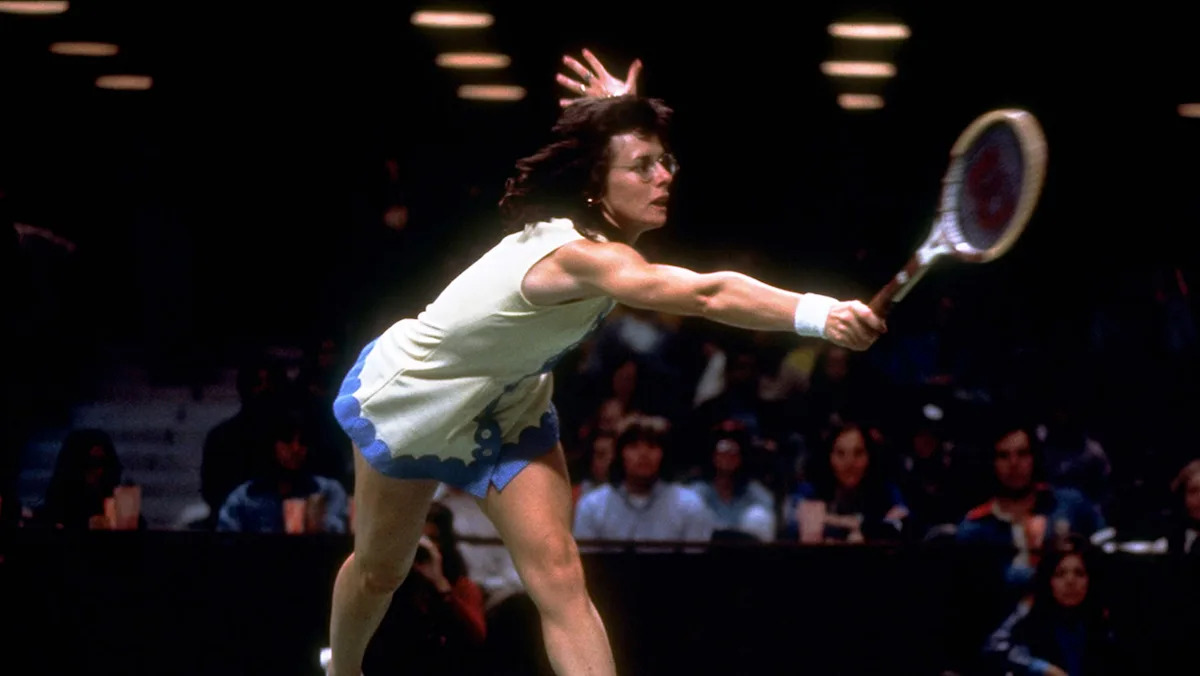

Prolific documentarian Liz Garbus and co-director Elizabeth Wolff celebrate the life and legendary achievements of championship tennis trailblazer Billie Jean King with infectious admiration and gratitude in Give Me the Ball! A nonfiction feature with the propulsive excitement of a great narrative, the film weaves a wealth of archival material around a captivating present-day sit-down interview with the octogenarian subject, who is candid, funny and unfailingly down-to-earth.
Made for ESPN Films’ sports history series 30 for 30, this is a superb biographical doc, a thrilling study of tennis greatness and an inspiring salute to a game-changer in women’s rights and LGBTQ visibility. The title earns its exclamation mark.
Advertisement
More from The Hollywood Reporter
The filmmakers plunge straight into one of the most tumultuous years in King’s storied career, 1973. She had already won the singles and mixed doubles titles at all four international Grand Slam events — Wimbledon and the Australian, French and U.S. Opens — with only the Australian Open eluding her in women’s doubles.
But King had a lot riding on a historic match at the Houston Astrodome that was christened “Battle of the Sexes.” (Also the title and subject of the crowd-pleasing 2017 comedy-drama that starred Emma Stone as King and Steve Carell as Riggs.) A former champion, Riggs was 55 at the time and King 29, but with characteristic braggadocio, he claimed women were such inferior players to men that he could easily beat even a current top player like King.
Riggs’ misogynistic windbaggery was especially grating to King when he started mouthing off about women not meriting the same pay or prize money as men, something she had fought hard for and was on the brink of achieving. Riggs also stirred up the backlash against ambitious women athletes by insisting they should be in the home making babies.
Advertisement
Given that King built her reputation on being an aggressive dynamo on the court, it’s moving to see her vulnerability as she anxiously prepares for the match and ponders the huge responsibility. “I didn’t want to put us back 50 years if I lost,” she says. “I have to win.”
A hilariously awful snippet shows prominent TV sports journalist Howard Cosell on camera with 25-year-old tennis pro Rosemary Casals, who was to serve as a commentator on the Battle of the Sexes broadcast, his arm draped so tightly around her neck that it’s practically a headlock. Seeing a bear-like man put such an invasive move on a woman less than half his age, making Casals visibly uncomfortable, is gross of course, but also pertinent to how much was still at stake with feminism.
Another announcer nonchalantly drops in that King could be a very attractive woman with Hollywood potential “if she’d ever grow her hair down to her shoulders and take off her glasses.” That kind of mid-century male chauvinism, as it was then called, remains jaw-dropping.
Garbus and Wolff were smart to make the $100,000 winner-takes-all Houston match and its surrounding circus the extended centerpiece of their film, allowing the contest to play out at length with nail-biting tension — even if we know the outcome. Editor Joshua L. Pearson, who does vigorous, precision-tooled work throughout with endless archival riches, is at the top of his game turning vintage footage from a half-century ago into visceral sports drama that puts you right there, courtside.
Advertisement
Inarguably the filmmakers’ greatest resource is their wide-ranging interview with King, now 82 and still a pistol, speaking with uninhibited openness about her upbringing, her introduction to tennis, her 22-year marriage to golden-haired Larry King, her first lesbian relationship and its troubled closing chapter, and her love for South African former tennis pro Ilana Sheryl Kloss, initially a carefully maintained secret but made public when King was outed. They married in 2018.
It seems an indication of what an easygoing, grounded person King is that she has maintained close friendships with Larry and his second wife, and that she and Kloss are their children’s godmothers.
Larry King also played a pivotal role in overcoming the prize money disparity issue, when he encouraged Billie Jean to break away from the male-dominated professional tennis circuit and start a women’s tennis tour with its own tournament. That required a sponsor and King speaks amusingly of how she quickly figured out that proud fathers of boys were a dead end while executives with families of sisters and daughters were far more likely to be interested.
The Kings found a deep-pocket investor in tobacco giant the Philip Morris Company, which figured women’s tennis would be a great way to promote its Virginia Slims brand of longer, thinner cigarettes, introduced in 1968 for the sophisticated, liberated woman. “You’ve come a long way, baby” was one of the now eye-rolling taglines.
Advertisement
The first Virginia Slims Tournament was in 1970, featuring the “Original 9” women players who broke away from the tennis establishment to run their own tour and prove that they could be just as big a draw as male athletes.
Along with King, original members Casals and Julie Heldman provide first-hand insights in new interviews, as does next-generation participant Chris Evert. In a lovely moment toward the end (that I’ll confess made me tear up), Serena Williams, who was coached by King at a tennis clinic when she was a kid, generously acknowledges just how much women in professional sports owe to her.
There’s lively input also from Elton John, a tennis fan who developed an enduringly close friendship with King. He was a queer person in the public eye who knew about the uneasiness of hiding in the closet, giving King someone to talk to about it when she was still confused about how or even whether to move forward as a lesbian. The pop icon wrote “Philadelphia Freedom” as a tribute to King; there’s delightful footage of her joining his backup singers on stage at a stadium show and bouncing around with joy.
Whether the focus is gender equality in financial compensation, homophobia in pro sports or even a severe eating disorder brought on by the stress of having to keep relationships with women secret at a time when almost no queer professional athletes were out, King is so candid and natural a subject that the movie never becomes even remotely heavy, preachy or didactic. For a woman who had such a transformative impact on sports, she comes across as refreshingly selfless. She doesn’t bother with false humility and is justly proud of her achievements, but she also has no need for the kind of chest-thumping vaingloriousness that makes Riggs such an obnoxious jerk.
Advertisement
King makes for a wonderful documentary subject, inspiring even for folks not particularly invested in sports, and this buoyant, massively entertaining and masterfully assembled film is exactly the glowing tribute she deserves.
Best of The Hollywood Reporter
Sign up for THR’s Newsletter. For the latest news, follow us on Facebook, Twitter, and Instagram.