

As his final news conference of 2025 came to an end, Xabi Alonso had one last word for the journalists gathered in the Santiago Bernabéu press room. Real Madrid had just beaten Sevilla 2-0 in LaLiga on Saturday and, before taking a well-earned Christmas break, Alonso had a point to make.
«Happy holidays to everyone,» he said, getting to his feet, before adding with a smile: «Tranquilos» («Keep calm»). It was a good-natured joke at the media’s expense after weeks of excitable speculation about Alonso’s future as coach thanks to a worrying dip in form.
The implication going into the league’s two-week festive holiday was: Don’t worry about me. I’m not going anywhere. See you in January.
– Stream LaLiga, Copa del Rey, Spanish Supercopa on ESPN+ (U.S.)
– Feliz ‘Mavidad’! Real Madrid turn Bernabéu pitch into winter wonderland
– Hunter’s midseason LaLiga verdicts: Barça, Real Madrid, Yamal, title race
Alonso’s first six months at Real Madrid have been anything but calm. «Tomorrow, the rock ‘n’ roll begins,» the coach said before his first game at the FIFA Club World Cup, and since then it has been nonstop drama.
The summer tournament in the U.S. — which ended for Madrid with 4-0 semifinal hammering by Paris Saint-Germain — soon forgotten, 2025-26 began with 13 wins in 14 games. Alonso’s team was seemingly a smooth-running, if unspectacular, machine.
Since then, the wheels have come off. If a 5-2 defeat to Atlético Madrid in September was a shock, a UEFA Champions League loss to Liverpool, followed by three consecutive draws in LaLiga and then defeats to Celta Vigo and Manchester City, felt like a full-blown crisis.
Sources told ESPN earlier this month that Madrid were considering their coaching options, and three, unconvincing wins last week — against Alavés, Talavera de la Reina and Sevilla — have done little to strengthen Alonso’s position. Despite his call for calm, the coach goes into Christmas with his future uncertain.
Madrid, and club president Florentino Pérez, are notoriously impatient when their coaches don’t deliver. Julen Lopetegui — poached from the Spain national team on the eve of the 2018 FIFA World Cup — lasted just 137 days. Rafa Benítez lasted 215.
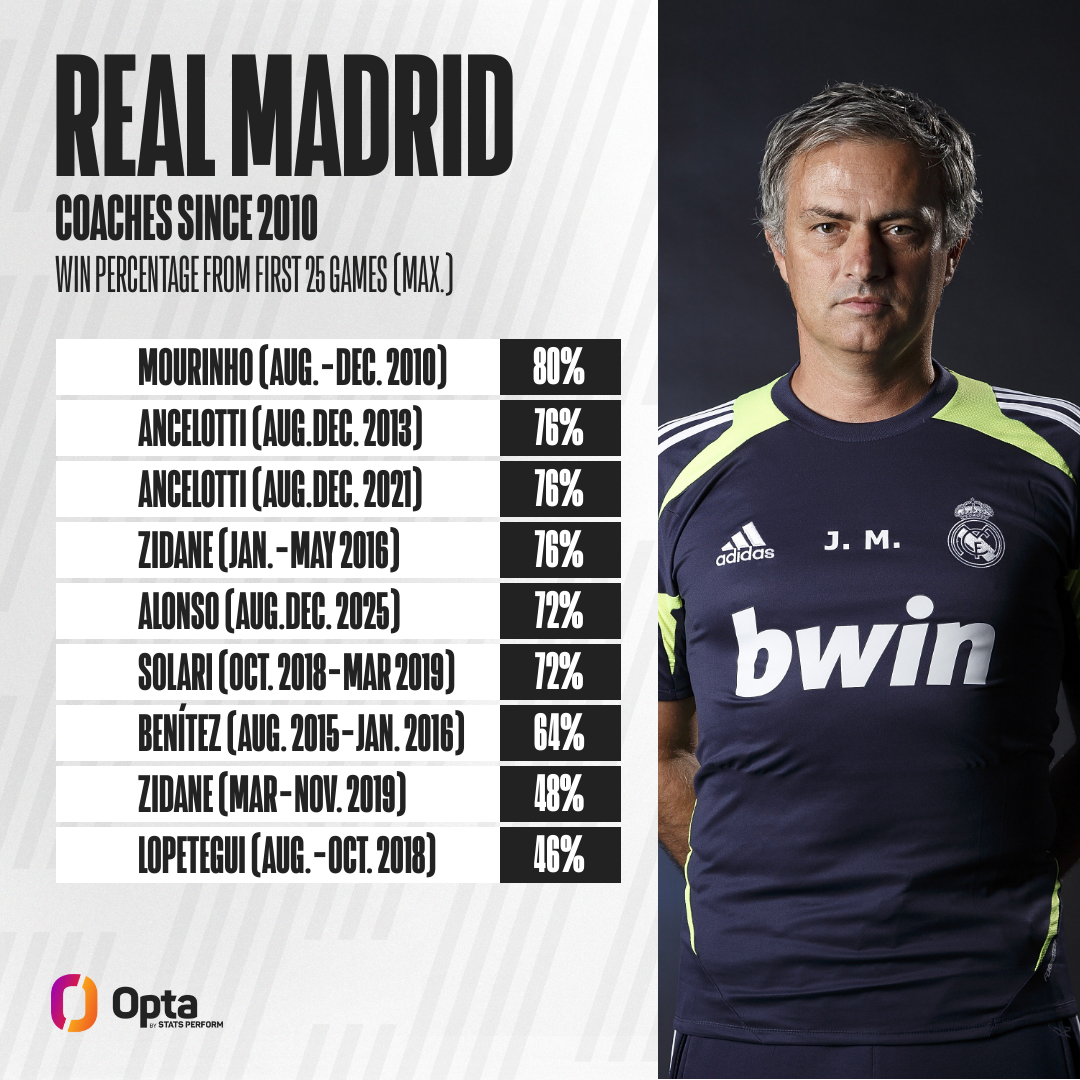
A look at the first six months for Madrid’s past 15 years of coaches, starting with José Mourinho in 2010, suggests that if Alonso has underperformed in comparison to his predecessors, it isn’t by much. The question for Pérez and his advisors is whether Alonso’s results are bad enough to justify sacking a highly-rated young coach, a club legend as a player, who became one of the most sought-after managers in football after his record-breaking achievements at Bayer Leverkusen.
For the purposes of this comparison, we’ve omitted Madrid’s Club World Cup games, given that Alonso has insisted on describing them as an add-on to last season, and none of his predecessors faced anything comparable. With Alonso’s team having played 25 matches in LaLiga, the Champions League and the Copa del Rey in 2025-26, we’ve looked at the first 25 games for Madrid’s previous coaches in those competitions — if they made it that far.
José Mourinho (August-December 2010)
Mourinho joined Madrid having just won the Champions League with Inter Milan. He arrived in LaLiga with a demanding brief: toppling Pep Guardiola’s Barcelona. He won an impressive 20 of his first 25 games in charge, with a win percentage of 80%, and keeping a frankly ridiculous 15 clean sheets. A squad packed with attacking talent — including Cristiano Ronaldo, Karim Benzema, Gonzalo Higuaín, Mesut Özil and Kaká, as well as a certain Xabi Alonso in midfield — posted some high-scoring wins, such as an 8-0 Copa del Rey thrashing of Levante. But there was also one, glaring loss: the famous 5-0 defeat to Barça at the Bernabéu, one of the most iconic results in Clásico history.
Carlo Ancelotti (August-December 2013)
After the high emotional toll of the Mourinho era, Madrid looked to calm things down with the cool head of Ancelotti. His 19 wins out of 25 gave him a start close to Mourinho’s, with a win percentage of 76%, and his team scored more goals (71, to José’s 67) but was, predictably, less defensively secure, conceding 26 times, to Mourinho’s 10. The team’s defeats were less dramatic, but nonetheless damaging: in September, they were beaten 1-0 at the Bernabéu by Diego Simeone’s Atlético Madrid, and in October, they lost 2-1 to Barcelona at Camp Nou.
Rafa Benítez (August 2015-January 2016)
Each coach at Madrid is often a reaction to the last, and Ancelotti’s easy-going, player-first regime was replaced by Benítez’s more hands-on, rigid approach. The results weren’t good, with just 16 wins in Benítez’s first 25 games giving him a mere 64% win percentage. There were more clean sheets than under Ancelotti — 12 in 25 games — and the team’s front three of Cristiano Ronaldo, Gareth Bale and Karim Benzema ensured some big wins, such as a 10-2 humbling of Rayo Vallecano in December. But by then, the damage had already been done. A 0-4 home defeat to Barcelona on Nov. 21, 2015 effectively spelled the end for Benítez, who abandoned his safety-first principles to play Toni Kroos, Luka Modric and James Rodríguez as a three-man midfield, with predictable results. By January, Benítez was gone.
Zinedine Zidane (January-May 2016)
Zidane inherited an unhappy squad under Benítez, with the team third in LaLiga, and led them to win the Champions League five months later. Stepping up seamlessly from reserve team Castilla, he matched Ancelotti’s 76% win percentage, with victories in 19 of his first 25 games, and found a balance between attack and defence, keeping 11 clean sheets. Even his biggest defeat — a 2-0 loss at Wolfsburg in the Champions League quarterfinals — became a triumph when the team turned the tie around with a 3-0 second-leg victory a week later. Zidane’s first six months were the opening chapter for the two, glorious years that followed, later adding two more Champions Leagues to make it three consecutive European Cups, a feat unmatched in the modern era.
Julen Lopetegui (August-October 2018)
Lopetegui’s reign lasted just four months. His appointment was controversial — his impending arrival was announced hours before he was due to take Spain to the World Cup, leading to his abrupt sacking from the national-team job. His time in charge wasn’t much better. A win percentage of 46% is comfortably the lowest on this list, with a short-lived bright start followed by a run of one win in seven games, including three consecutive defeats in LaLiga. The team went almost eight hours without scoring a goal between September and October — an inauspicious start to the post-Ronaldo era — and suffered a decisive 5-1 defeat to Barcelona at Camp Nou on Oct. 28. That left Madrid ninth in LaLiga. «The board understands that there is a great difference between the quality of the Real Madrid squad, which has eight players nominated for the Ballon d’Or, and the results achieved until now,» a club statement read as Lopetegui was dismissed after 14 matches.
Santi Solari (October 2018-March 2019)
Solari — like Zidane, an internal promotion from Castilla — is now largely viewed as a failure, but the stats from his first 25 games in charge are actually fairly solid, with a 72% win percentage — winning 18 matches, drawing two, and losing five — and 10 clean sheets. The team’s scoring took a hit, though, with 57 goals scored in that time, fewer than under Mourinho, Ancelotti, Benítez or Zidane. Solari took some important decisions, dropping the underperforming Marcelo and Isco, and giving opportunities to a young Vinícius Júnior. But the real damage came later, when back-to-back defeats to Barça were followed by a fatal 4-1 home loss to Ajax in the Champions League.
Zinedine Zidane (March-November 2019)
Zidane returned at a difficult time, as Madrid’s third coach in a chaotic campaign which ended without winning a major trophy. His early results reflected that, with four defeats before the end of 2018-19 contributing to a 48% win percentage in his first 25 games back in the job. The team struggled at both ends of the pitch, scoring just 40 goals and conceding 28. The situation improved for the start of 2019-20, with the only disappointment being a 3-0 European loss to PSG. The team would later go on to clinch the LaLiga title in a season disrupted by the outbreak of the COVID-19 pandemic.
Carlo Ancelotti (August-December 2021)
If Zidane’s second spell didn’t hit the heights of the first, the same can’t be said of the unexpected return of Ancelotti. The Italian’s first 25 games back in charge were near flawless, the only exception being two consecutive defeats in late September and early October, to FC Sheriff and Espanyol. Otherwise, Ancelotti’s Madrid won 19 matches, to give him a 76% win percentage — matching that of his debut as coach — with a 15-game, three-month unbeaten streak between October and the New Year. That run included wins over rivals Barcelona — 2-1 at Camp Nou — and Atlético. Madrid, and Ancelotti, were back, and went on to win a LaLiga and Champions League double.
1:02
Alonso on Real Madrid’s board: ‘We’re in this together’
Real Madrid manager Xabi Alonso denies tension with the board amid questions about his future at the club.
Xabi Alonso (August-December 2025)
So, to Xabi. His 72% win percentage in his 25 games so far this season can’t match Mourinho, Ancelotti or Zidane. It’s the same as Solari’s — but that equates to just one win fewer than Ancelotti or Zidane (18, compared to their 19), and those two are now considered Madrid’s most successful, decorated coaches of the modern era.
Alonso’s team aren’t scoring as many goals as his predecessors — averaging 2.08 goals per game, compared to Mourinho’s 2.68, Ancelotti’s 2.84 (in his first spell) or even Benítez’s 2.64. At the other end, they are conceding an average of a goal per game, which matches Ancelotti, but can’t compete with Mourinho (0.4), Benítez (0.84) or Zidane’s first spell (0.72).
The highpoint for Alonso was the 2-1 Clásico win over champions Barcelona at the Bernabéu on Oct. 26. A week later, a 4-0 victory over Valencia made it 13 wins out of 14, a feeling of momentum building. But that has fizzled out entirely in the 11 games that have followed, which have included three defeats, three draws, and only one really good performance, a 3-0 win at Athletic Club on Dec. 3.
Alonso’s team might statistically be running just behind Ancelotti’s or Zidane’s after 25 games, but the feelings — the sensations, as they say in Spain — are of a team which is regressing, getting lost just when it should be finding itself. The frequent whistles from the Bernabéu crowd during the game against Sevilla last weekend were a sign that the fans are getting just as restless as president Pérez.
There are explanations, of course, for the teams’ predicament. Alonso, in his last news conference, pointed to an injury crisis which left him, at one point, without 11 first-team players. And even if there aren’t any concrete signs of it yet, given time and patience, Alonso’s track record suggests he’s capable of turning the situation around.
But at the Bernabéu, patience is the one resource which is in short supply.