

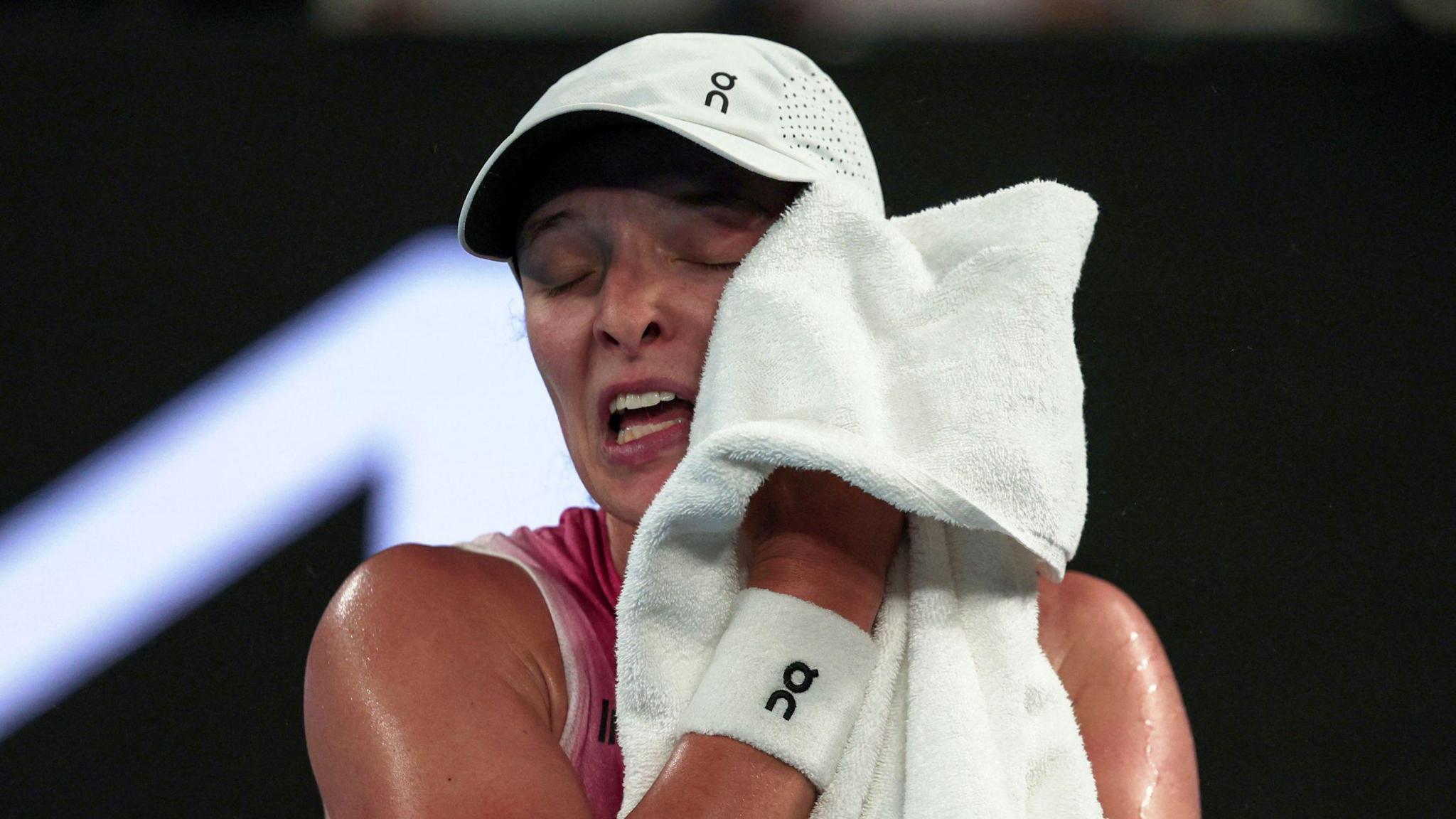

When Daria Kasatkina cut her 2025 season short in October, the former world number eight described how she had «hit a wall».
«The schedule is too much. Mentally and emotionally I’m at breaking point and, sadly, I’m not alone,» she wrote.
Ukraine’s Elina Svitolina, a two-time Wimbledon semi-finalist, had already announced she was not in «the mental space» to continue, while reigning Grand Slam champions Iga Swiatek and Carlos Alcaraz believe the calendar is too long.
The topic continues to be debated as the world’s leading tennis players reconvene in Australia for the start of the 2026 season.
A slightly longer off-season than 2025 has been welcomed. Nevertheless, several weeks is not seen as enough time for proper recuperation before preparations begin for an 11-month campaign regarded as among the most onerous in professional sport.
«The demands of tennis are harder than ever before,» Dr Robby Sikka, medical director at the Professional Tennis Players’ Association (PTPA) co-founded by Novak Djokovic, told BBC Sport.
«Matches and rallies are longer, players are faster, they’re hitting the ball harder.
«We owe it to our players to protect them and give them a more sustainable sport.»
So what is being done and what further steps could be taken?
Shortening the season
The 2025 season spanned 47 weeks for many men, beginning with the United Cup team event on 27 December 2024 and ending with the Davis Cup final on 23 November.
The women’s season finished two weeks earlier when the WTA Tour Finals concluded on 8 November. The ITF moved the Billie Jean King Cup Finals forward to September to help combat scheduling concerns.
The ATP Tour says it does not take the concerns of the players «lightly», while the WTA Tour says player welfare will «always remain a top priority».
That did not appease the PTPA, which began legal action against the men’s and women’s tours in March, citing «anti-competitive practices and a blatant disregard for player welfare».
Set up in 2020 by Djokovic and former Wimbledon doubles champion Vasek Pospisil with a mission of protecting players’ interests, the PTPA says the length, physicality and scheduling of matches is taking its toll.
Revamping the calendar is an obvious solution but cannot be achieved easily given the complex nature of tennis governance, where the four Grand Slams, ATP, WTA and ITF each have controlling interests.
«We need to think about whether we can buy back time at the end of the year for an extended off season, or can we buy time during the season so there is a mini-break,» said Dr Sikka, who is also a team physician for the New York Yankees.
Former world number one Andy Roddick, who has long advocated for change, says the season should not go past 1 November.
The ATP Tour has cut the number of events which count towards the rankings from 19 to 18 for 2026, which it believes will reduce «overall demands» on the players.
The WTA rankings are also based on 18 tournaments, but the leading players are expected to play at least 20 mandatory events – four Grand Slams, 10 WTA 1000s and six 500s.
«One point that often gets overlooked: players choose their own schedules,» ATP chairman Andrea Gaudenzi said.
«That freedom is rare in professional sport. But with that comes responsibility – knowing when to push and when to recover.»
Stretching several ATP and WTA mandatory tournaments across a fortnight – creating so-called ‘mini Slams’ – has also been criticised.
«I think players are more mentally tired and more fatigued because they’re spending more days away and more days on the road,» Andy Murray, Britain’s former men’s world number one, told The Tennis Podcast.
As well as mental burnout, there are concerns about the increased physical demands.
Players suffer more severe upper-body injuries in April, August and October, according to PTPA data.
The organisation says these «predictable clusters» are down to the structure of the calendar and the turnarounds between court surfaces.
Fewer late nights & more ball consistency
When Murray infamously finished an Australian Open match at 04:05 local time in 2023, it promised to spark change.
In 2024, the WTA and ATP brought in a rule preventing matches starting after 11pm.
But there have continued to be instances of matches finishing well past midnight – which Dr Sikka insists cannot be allowed to be «romanticised».
«When you are done playing you just don’t go home. You have to do media, recover, work with the physiotherapist, then you go to hotel and unwind,» he added.
«Your day doesn’t end at midnight or 1am, it ends at 3/4am. Then the next day you have to go in and hit.
«Your body, brain and nerves don’t have chance to recover. There is no other sport which mandates that.»

Different tournaments playing with different balls – leading to changes in weight and pace – has been cited as a source of increased upper body injuries.
Britain’s Katie Boulter says players want more ball consistency from week to week.
«I’ve had a lot of injuries in my arm, my shoulder, my wrist and I’m seeing more and more of these injuries across the tours,» she told BBC Sport in May.
Former US Open champion Dominic Thiem, who retired last year with an ongoing wrist injury, believes tournaments in the same swing should use one ball.
«It shouldn’t be too difficult – the same ball for clay, the same for hard and the same for grass. That would be really helpful to the players,» he said.
The tours adopted a more centralised ball-selection system during 2025 and the ATP expects «full alignment» by 2027.
Learn from NFL & protect young players
Sports scientists believe tennis must learn from how American team sports use data to guide the wellbeing of its stars.
Following data-led analysis, the NFL demanded consistent playing surfaces and improved helmet technology to reduce the risk of injury.
«NFL has made many rule changes based on empirical evidence and data information,» said Kitman Labs founder Stephen Smith, whose firm provides professional sports teams with data and analytics to monitor player welfare.
«We’ve seen the economic model is skyrocketing because their games are so competitive and they’re keeping players out on the field.
«They’re putting their money where their mouth is by protecting athletes and investing hugely – that model is the gold standard.»
The MLB has introduced rules aimed at protecting pitchers, limiting their throws at the professional level and putting age restrictions on how much young players can pitch.
Thiem believes the load put on the upper body of tennis players from a young age is a significant factor in their injuries later on – including his own.
«We start playing from such an early age and have so many repetitions of our groundstrokes,» said the 32-year-old Austrian.
«At some point it goes on the wrist. Way more players have problems with the wrist. I think the problem is the many, many repetitions.»
Players ‘motivated’ for change – what do they want?
An increasing number of players are finding their voice about the demands placed on them.
World number ones Alcaraz and Aryna Sabalenka are among a group of stars ramping up pressure on the Grand Slams with calls for a larger share of revenue, as well as meaningful consultation about the length of the season, elongated tournaments and scheduling.
Last year, American men’s world number six Taylor Fritz said it was «absurd» he was only able to take one week off tennis before the 2025 season.
Sympathy can be in short supply, though, given top players including Alcaraz and Fritz sign up to lucrative exhibition events.
-
Players voice burnout fears over tennis schedule
-
1 June 2025
-
-
Are exhibitions impacting ‘tight’ tennis calendar?
-
21 October 2024
-
-
ATP announces new rules over playing in extreme heat
-
16 December 2025
-
Britain’s Emma Raducanu says the grind is a «challenge» but thinks top players «moaning about the calendar» is not a good look.
«Uniformly the players are very motivated for change,» added Dr Sikka, who says the PTPA has provided data analysis to «well over 100 players» to guide recovery and welfare.
«Not only because their success and income is tied to being healthy, but because we live in a world where everyone is more health conscious than ever before.
«Not everyone can be Novak Djokovic or Rafael Nadal. Players know that. Our mission is making them the best and healthiest version they can be.»
Related topics
- Tennis
-
Live scores, results and order of play
-
Get tennis news sent straight to your phone
-
16 August 2025

-