
In August 2021, Rakan Alireza quit his corporate job to pursue a goal so audacious that no one else from his desert nation had ever attempted it.
The 24-year-old began training to represent Saudi Arabia on a global stage as a cross-country skier.
Advertisement
Alireza was among the first athletes selected by the Saudi government after it proclaimed that the country’s lack of ski slopes and snowy peaks shouldn’t inhibit its winter sports ambitions. The Saudis conducted a nationwide search for athletes with any shred of skiing or snowboarding experience. They sought to unearth a handful of promising novices and invest heavily in grooming them for international competition.
While Alireza had only skied recreationally during boarding school or while traveling abroad with his family, the Saudi Winter Sports Federation believed in his potential as a cross-country skier. Alireza participated in the CrossFit Games and achieved one of Saudi Arabia’s highest rankings. The fitness fanatic’s strength and endurance would serve him well traversing rugged terrain on skis, Saudi officials projected.
Alireza vividly recalls the skeptical response when he told his parents that he aimed to qualify for the Winter Olympics.
“You’re actually going to leave a career to do this?” Alireza’s father asked incredulously. “You’re going to be competing against people born with skis on their feet!”
Advertisement
Alireza’s mother was initially more supportive … until she learned he was stepping down from his consulting job with Price Waterhouse Coopers in Riyadh.
“She told me it didn’t make sense,” Alireza said. “She thought it was a hopeless case.”
Nearly five years later, even Alireza’s parents might admit he was correct to ignore their advice. The pioneering Alireza has opened doors for future generations of Saudis and helped redefine what’s possible for a winter sports athlete from a desert nation with virtually no snow.
Alireza made history Friday when he becomes the second Saudi athlete to compete at the Winter Olympics and the first to represent the Kingdom in cross-country skiing. The only other Saudi to reach the Winter Olympics is Alpine skier Fayik Abdi, who qualified for Beijing in 2022 and for this year’s Games.
Advertisement
Whereas making it to the starting line at the Olympics is the culmination of years of dogged effort and sacrifice for Alireza, the achievement is merely a starting point for his country. Saudi Arabia envisions itself becoming a future winter sports giant, the type that doesn’t just send athletes to participate in the Olympics but to return home with medals around their necks.
“I think the whole world is going to know about us soon,” said Leon Svetlin, the former Bosnian skier who since October 2022 has served as the Saudi Winter Sports Federation’s head coach and Alpine sports director. “There is a vision for the future and strong institutional support from the country. When you have that, you can get results in a shorter period of time.”

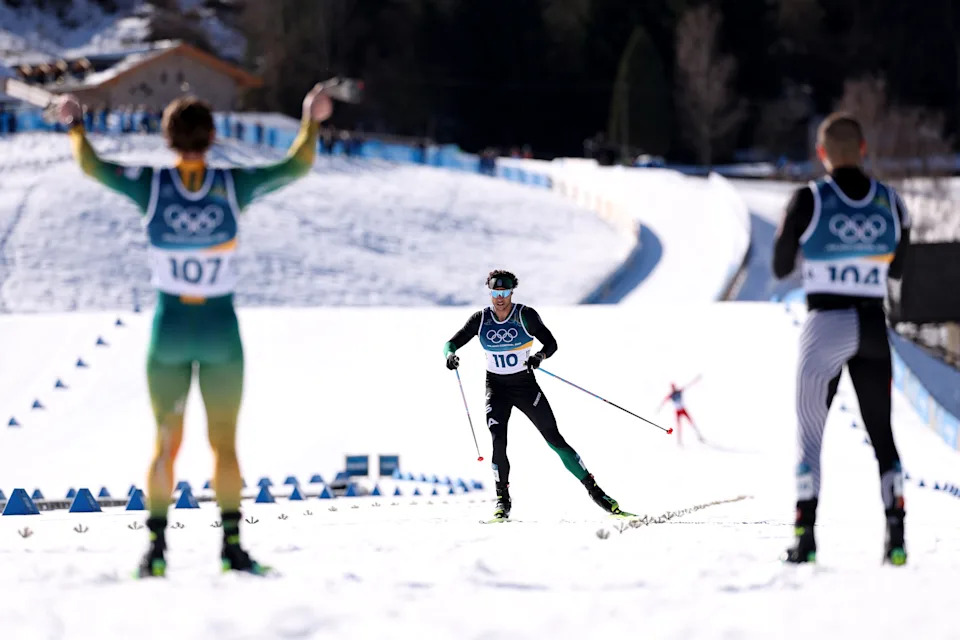
Rakan Alireza approaches the finish line in the Men’s 10km Interval Start Free on day seven of the Milano Cortina 2026 Winter Olympic games at Tesero Cross-Country Skiing Stadium. (Photo by Lars Baron/Getty Images)
(Lars Baron via Getty Images)
‘Bambi on ice’
The biggest reason Saudi Arabia cannot be taken lightly as a potential winter sports power is its financial might. Since the oil-rich country is still at least a couple years away from providing access to ski slopes within its borders, the Saudi government has spared no expense housing winter sports athletes in Europe for months at a time.
Advertisement
Alireza’s transformation from cross-country skiing novice to future Olympian began in August 2021 when the Saudi government sent him to Sweden to train inside a famous underground ski tunnel with hilly terrain and year-round snow. It was there that he began working with the top-tier European coaches hired by the Saudis to teach him the proper technique.
Only minutes into Alireza’s first training session, the young Saudi realized he’d underestimated the challenge he faced. It took him five minutes to even step into his cross-country ski bindings. Then once he did, he resembled Bambi on ice.
“I kept falling down, Alireza said. “There were all these young kids whizzing past me. Seeing where they were compared to where I was, it was kind of terrifying.”
Eagerness to learn and willingness to suffer has helped Alireza improve. He trains up to five hours per day, alternating between skiing and high-intensity endurance work. When in Europe, he takes advantage of the opportunity to ski on snow. When back home in the desert city of Jeddah, he rollerskis, sometimes with a tire strapped to his back to mimic the resistance of snow conditions.
Advertisement
Those efforts were enough to help Alireza secure his place at these Olympics, but the gap remains wide between the 29-year-old Saudi and European or North American competitors who grew up on skis. Alireza arrives in Italy ranked outside the top 2000 globally in both the men’s sprint and distance cross-country disciplines. He estimates that he still has been on skis fewer than 200 times in his life.
“I still consider myself a beginner,” Alireza said. “You can see it in my fundamentals. Mid-race I’ll see someone doing something and I’ll try to copy it. If it works, good. If not, I learn.”
It’s no mystery to the Saudis that they’re unlikely to challenge for podium positions on a global stage unless their winter sports athletes hit the slopes earlier in life. They have to find ways to introduce Saudi boys and girls to skiing and snowboarding during childhood and create developmental pathways for those who display promise.
“That’s one of the biggest challenges for us,” Svetlin admitted. “Normally to reach your peak as a skier, you need 10-15 years of continuous training. In Saudi Arabia, we still don’t have a ski slope and it’s not realistic to ask kids to travel all the way to Europe to start training from a very young age.”

The Trojena project to build a ski resort in Saudi Arabia is one of the most ambitious and difficult construction undertakings in the world. (Laurent Coust/SOPA Images/LightRocket via Getty Images)
(SOPA Images via Getty Images)
A desert ski resort?
The potential solution to Saudi Arabia’s snow problem is a project that is both wildly ambitious and lavishly expensive. In 2022, as part of Crown Prince Mohammed bin Salman’s plan to boost tourism, attract major events and diversify the country’s oil-dependent economy, Saudi Arabia unveiled plans to build a sprawling, futuristic outdoor ski resort known as Trojena.
Advertisement
While the mountains where the ski resort will be situated do occasionally get a dusting of snow during the winter, it’s nowhere near enough to create a winter sports destination. As a result, Saudi Arabia intends to rely on state-of-the-art snowmaking technologies to manufacture more than 30 kilometers of ski slopes.
Will the project be complete in time for Saudi Arabia to fulfill its duties as the designated host for the 2029 Asian Winter Games? That’s not yet clear. Satellite imagery taken last year shows that construction of the ski resort is underway, but delays have reportedly led the Olympic Council of Asia to begin making contingency plans elsewhere in the region.
Whenever the ski resort opens, it has the potential to be a game changer for the development of winter sports athletes from Saudi Arabia, Svetlin says. So do planned indoor ski resorts in the Saudi capital of Riyadh and elsewhere.
Advertisement
“Hopefully in the next couple years we’ll get a chance to train there and compete there,” Svetlin said. “I think that will make it possible for us to find even younger athletes and create an even better platform for the future.”
Svetlin is also intrigued with the idea that rollerskiing could become a training option for Saudi kids who are interested in cross-country skiing but don’t have access to snow. He believes that could help Saudi Arabia produce high-level results in cross-country skiing faster than other skiing and snowboarding disciplines.
It will also help having a trailblazer like Alireza who has kicked open doors that were once shut. When Alireza and his fellow Saudi skiers first began training, he remembers coaches from other national teams openly laughing at their ineptitude.
“Now those same coaches have become our fans,” Alireza said. “They would cheer for us and support us when they saw the improvement.”
Advertisement
Alireza takes immense pride in making the Olympics, but he’s hopeful this is just the beginning for his desert country in winter sports.
There’s already another younger Saudi cross-country skier pushing Alireza. His goal is to be better than Alireza and Alireza is rooting for him. He often says to the newcomer, “I want you to retire me, but I’m never going to make it easy on you.
“I tell him going to the Olympics is no longer special if I did it,” Alireza said. “You’re going to be the second one to do it? No one really cares. Go do something better.”