
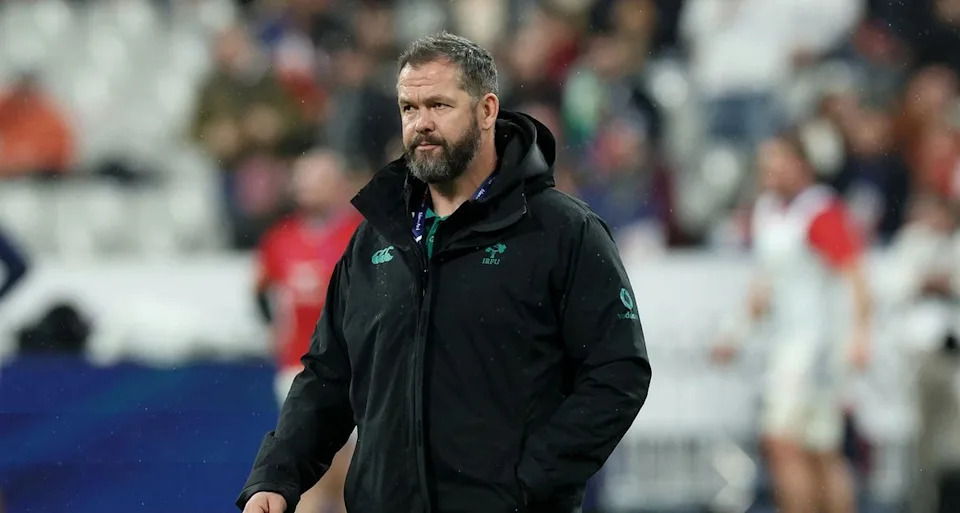
Gathered in the dressing room after a troubling night, the Irish players sat and listened as Andy Farrell expressed his frustration. It is rare for the Ireland coach to so outwardly shows his distaste for aspects of his side’s performance but this was a night for harsh truths. As he said to ITV, and repeated later: “I’m obviously very disappointed, through something that I never thought we’d be saying about this Irish team, we had a bit of a lack of intent in that first-half – missed tackles, winning the scraps on the floor or the fight in the air, it’s just intent. And if that’s lacking you’re not going to win any international game, never mind one in Paris.”
The striking thing was how different this felt. Most have seen the Irish slide coming over these last 12 months but even in their toughest days in that time, one has never been able to question their want, desire or quality. Indeed, even on a day where the Springboks dismantled their scrum and caused questions about the very fabric of the game in November, there was a point in the final few minutes where it felt like Ireland could snatch it. In Paris, any prospect of an Irish victory disappeared quickly into the drizzly night.

(Getty Images)
Caelan Doris, the captain, said little in the dressing room immediately afterwards but took on a key message. “Come in with a proper opinion,” Farrell had demanded of his players when they reassemble ahead of round two – after a few problems were laid bare, the onus will be on the squad to identify and address them. “We don’t want to be a team that is chasing,” Doris reflected. “We left ourselves too big a mountain to climb.”
Advertisement
As ever, one should not overreact to a single week but Farrell’s frustration told a tale. If, as Hemingway didn’t quite write, the collapse of a great rugby team comes gradually, then suddenly, the fear in some Irish quarters will be of a side no longer able to mix it with elite company. Now, there is mitigation for aspects of their Paris no-show – 12 injuries, a prop crisis, Bundee Aki’s suspension – but so much of their game was short of where it needs to be, with Ireland dominated aerially and on the gainline. The bounce of the ball favoured the French but, as Farrell said: «I think you make your own luck in this game.”

(Getty Images)
Certainly, there is a sense that the head coach’s British and Irish Lions sabbatical may have come at just the wrong time for a squad in need of regeneration. No-one would begrudge the Englishman for taking the opportunity, nor for taking a healthy Irish contingent with him, but it almost pressed pause on efforts to reload and retool. While England and Scotland accelerated the development of their next generation on tough tours to Argentina and the Pacific Islands, games against Georgia and particularly Portugal last July were not, perhaps, the best in which to assess the Test readiness of those knocking on the door.
Farrell was seemingly frustrated by a perceived lack of preparation time ahead of this Thursday night start, despite taking his squad for their customary training camp on the Algarve. There is a suspicion that the divergence in strategy between Ireland and Leinster in the last couple of years has meant it takes longer for some to get up to speed, with those from the other three provinces facing more acute challenges. The highly-talented Edwin Edogbo might have pressed for a debut in Paris had he been in an Irish camp before; he most likely would not have made much difference but Farrell felt the lock was not quite fully up to speed in the way required.
Advertisement
It has been a funny season for Irish sides in the United Rugby Championship, with Munster unable to sustain a strong start and Leinster winning often without playing well. The form of Ulster is reason for encouragement, but whether the next crop of Test match animals are really emerging remains a point of doubt. That is a natural fluctuation in a nation with a reasonably small player base. There is also a sense that international rugby has evolved beyond the Irish dogma. Where once their highly-accurate, highly-intense multiphase attack ruled, increasingly the sport is becoming one of quick strikes in transition out of the kick contest, an area in which Ireland are not necessarily strong.

(AP)
That is an issue that at least feels solvable. France produced a vastly improved showing aerially after making it a point of progress, and it should be said that Ireland were without two of their preferred back three due to injury. The fly half question might be a tougher one to answer – Sam Prendergast’s low floor, and particularly his defensive deficiencies, are currently more evident than his high ceiling. It is strange to think back two years to Marseille when Jack Crowley seemed to seize the occasion and that No 10 shirt. While the Munsterman has lost form, and perhaps confidence, Prendergast remains without that sort of statement showing. While their Six Nations hopes are not totally lost, he, and Ireland, have thinking to do.