

-

Kevin Seifert
Super Bowl LX is in the books. The Seattle Seahawks, who entered the season with a 1.1% chance to win the Super Bowl based on ESPN Analytics projections, beat the New England Patriots 29-13 to take home the Lombardi Trophy.
Now begins the process of building the Super Bowl LXI champions through an offseason that will be characterized, in part, by the usual imbalance of available quarterbacks relative to demand. Nearly a third of the NFL could be seeking a new quarterback this offseason, but the 2026 draft is projected to be particularly light at the position, and no stars are looming in free agency.
Off the field, the NFL will need to reconcile the concussion rate on its redesigned kickoff and also consider whether to empower replay officials with the authority to throw flags in certain situations.
The offseason process will begin accelerating in the coming weeks. Teams can begin using the franchise tag Feb. 17, and the scouting combine opens Feb. 23 in Indianapolis. There are 29 days remaining before NFL teams can (legally) begin contacting pending free agents and 72 days until the NFL draft in Pittsburgh.
Let’s take a closer look at how the 2026 offseason will shape up for its teams, players and league decision-makers.
 Aaron Rodgers and tight end Travis Kelce. (Los Angeles Rams quarterback Matthew Stafford, 38, said last week that he plans to play in 2026.)
Rodgers, 42, did not commit either way after the Pittsburgh Steelers’ wild-card playoff loss, but it’s worth noting that the Steelers hired his former Green Bay Packers coach — Mike McCarthy — after Mike Tomlin’s resignation. Kelce, 36, said he would spend some time after the season talking to his family before deciding whether to return to the Kansas City Chiefs.
Rodgers’ decision will be one of the first dominoes to fall on what is a relatively thin group of free agent quarterbacks.
Which other QBs could move?
At least six and up to 10 teams will be seeking a starting-caliber quarterback this season, whether it is the Las Vegas Raiders, who hold the No. 1 pick, or the Minnesota Vikings, who want competition for J.J. McCarthy.

1 Related
The Raiders will almost certainly draft Indiana quarterback Fernando Mendoza with the No. 1 pick, but the rest of the teams will gauge their options via free agency or trades.
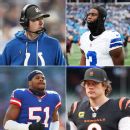
The top pending free agents include Rodgers, Daniel Jones, Malik Willis, Gardner Minshew and Jimmy Garoppolo. If Rodgers plays in 2026, it seems likely it would be for the Steelers. The Colts have expressed strong interest in bringing back Jones, who tore his right Achilles tendon in Week 14. Two veteran quarterbacks under contract, the Raiders’ Geno Smith and the Atlanta Falcons’ Kirk Cousins, are candidates to be released.
Teams in search of a quarterback might find better options via trade. Among those who could be available are the Arizona Cardinals’ Kyler Murray and the Miami Dolphins’ Tua Tagovailoa. The Cincinnati Bengals’ Joe Burrow sparked trade rumors after some vague answers about his future at the end of the season, but it’s far from clear that the Bengals would consider moving him.
Mendoza and ___ in the 2026 draft?
Though Mendoza is the clear top pick in the draft, the rest of the quarterback class is tough to parse. In his recent mock draft of Rounds 1 and 2, ESPN’s Matt Miller included only two passers: Mendoza and Alabama’s Ty Simpson, whom he had going to the New York Jets in the middle of the second round.
Along with Mendoza, the top-five players on Mel Kiper Jr.’s first big board of the draft season included two linebackers (Ohio State’s Arvell Reese and Texas Tech’s David Bailey), one running back (Notre Dame’s Jeremiyah Love) and one receiver (Ohio State’s Carnell Tate).
Who could be traded?
In addition to the quarterbacks, several other veterans could be available via trade. Atop the list is Raiders defensive end Maxx Crosby, whose 2025 season ended early because of a torn right meniscus. Crosby, 28, might not want to go through another rebuilding process with the Raiders, who recently hired their fourth coach in the past four seasons.
Other players to watch include Philadelphia Eagles receiver A.J. Brown, Dolphins receiver Tyreek Hill and Buffalo Bills receiver Keon Coleman.
free agent class will look like. One way or another, through the franchise tag or contract extensions, many players whose contracts are expiring will remain with their current team by the time free agency begins.
But for now, the theoretical free agent list includes edge rushers such as Trey Hendrickson (Bengals) and Odafe Oweh (Chargers). Teams in need of an offensive tackle might consider Rasheed Walker (Packers) or Braden Smith (Colts). Alontae Taylor (Saints) might be the best cornerback available. After a monster year in 2025, receiver George Pickens (Cowboys) is in line for a big deal. Running backs Breece Hall (Jets) and Travis Etienne Jr. (Jaguars) can make big impacts on an offense in different ways.
Who will get contract extensions?
The 2023 NFL draft class is eligible for contract extensions. Here is a partial list of the players you’ll be hearing about in the coming month, based in part on Pro Football Reference’s approximate value metric.
Quarterback: C.J. Stroud (Texans), Bryce Young (Panthers)
Running back: Bijan Robinson (Falcons), Jahmyr Gibbs (Lions), De’Von Achane (Dolphins), Chase Brown (Bengals)
Receiver: Jaxon Smith-Njigba (Seahawks), Zay Flowers (Ravens), Jordan Addison (Vikings), Puka Nacua (Rams)
Tight end: Sam LaPorta (Lions), Tucker Kraft (Packers), Dalton Kincaid (Bills)
Offensive tackle: Darnell Wright (Bears), Anton Harrison (Jaguars)
Interior offensive line: O’Cyrus Torrence (Bills)
Defensive tackle: Kobie Turner (Rams)
Edge rusher: Byron Young (Rams), Will Anderson Jr. (Texans)
Linebacker: Jack Campbell (Lions)
Secondary: Devon Witherspoon (Seahawks), Christian Gonzalez (Patriots), Brian Branch (Lions), Joey Porter Jr. (Steelers)
What is the aftermath of this coaching cycle?
Nearly a third of NFL coaches have been replaced, a total of 10. When the dust settles, however, a bigger trend will emerge.
Coinciding with that turnover, nearly two-thirds of teams (21) will have a new offensive coordinator. For comparison, there are 13 new defensive coordinators in 2026.
Not all of the offensive coordinators will have playcalling duties, but 16 teams will have new playcallers via a change at offensive coordinator or head coach. In other words, half of the league’s teams will be revamping their offenses at some level. That increases the chances for new schemes, or unique applications of existing schemes, in a way that will make the 2026 season a bit less predictable than it otherwise would have been.
minority background — the Tennessee Titans’ Robert Saleh. That leaves the NFL, whose players are roughly 54% Black, with three Black head coaches: the Tampa Bay Buccaneers’ Todd Bowles, the Houston Texans’ DeMeco Ryans and the Jets’ Aaron Glenn.
That outcome coincided with the NFL’s decision to put its annual Accelerator program, designed to connect diverse candidates directly with league owners and decision-makers, on hiatus in 2025. The league plans to bring back the program in some form this year, and Goodell stressed this month his commitment to labor diversity through the Rooney Rule. But that philosophical pledge did not match outcomes during the 2026 cycle.
«There’s got to be more steps,» Goodell said. «So, we’re reevaluating everything we’re doing … including every aspect of our policies and our programs to meet the challenges of today and tomorrow, rather than yesterday.»
How will the NFLPA transition?
The NFL Players Association has yet to name a permanent replacement for executive director Lloyd Howell, who resigned last summer. David White has been serving in the interim since then, and NFLPA president Jalen Reeves-Maybin said the union is continuing to work with a search committee to source candidates. White was a finalist when Howell was named to the job in 2023, but White has not yet been informed if he is a candidate during this round, Reeves-Maybin said.
White said earlier this month that the union has «stabilized the operations» and has been «strengthening our foundation.» But it almost goes without saying that the NFLPA needs a permanent leadership structure before moving forward on the biggest issues it faces, from the potential of an 18-game season to collective bargaining negotiations and player health and safety.
seeking testimony from Goodell and multiple owners.
Meanwhile, Vikings defensive coordinator Brian Flores is fighting to keep his dispute with the league and its owners over hiring practices in court. Flores’ lawsuit dates back to his firing as the Dolphins’ coach after the 2021 season and his contention that some teams engaged in «sham» interviews as he sought another job in the weeks after.
Tush push redux?
Even after NFL owners nearly banned it — and some league officials promised to try again in the near future — a handful of teams continued using a steady diet of the specialty short-yardage play. Overall, there were slightly more tush push plays in 2025 (112) than in 2024 (101).
The Eagles (27) and Bills (17) continued to account for much of the trend, but other teams began experimenting with using tight ends rather than quarterbacks to take the snap, most notably the Steelers and Seattle Seahawks.
There have been no immediate clues on whether owners will revisit the issue during their scheduled meetings in March and May. It was slightly less effective in 2025, converting first downs at a rate of 76.8% compared with an 82% rate from 2022 to 2024, but that isn’t likely to be enough of a drop for teams to stop using it on their own.
Is an 18-game season linked to the international schedule?
NFL owners have been talking for years about shifting their 20-game schedule (three preseason plus 17 regular season) to two preseason and 18 regular-season games. They have also made clear their interest in expanding their international reach. And they’ve never pretended that growing revenues is anything other than a top priority, for them and players.
Earlier this year, New England Patriots owner Bob Kraft connected those three goals in a concise way that clearly illustrates the league’s business priorities for this offseason and beyond.
In a radio interview with 98.5-FM, Kraft said, «We’re going to push like the dickens now to make international more important to us.» He spoke as if an 18-game season is a certainty — even though the NFLPA has yet to agree — and endorsed Goodell’s plan to schedule enough international games (16) for every team to play in at least one every season.
Kraft implied that the league is close to reaching its domestic revenue ceiling. But with an 18-game regular season and more international expansion, he said, «We can keep long-term labor peace» by sharing those higher revenues through the existing split in the collective bargaining agreement.
It remains to be seen how the NFLPA will respond to upcoming proposals. In a news conference last week, the NFLPA’s White said: «Our members have no appetite for an 18th game.»