

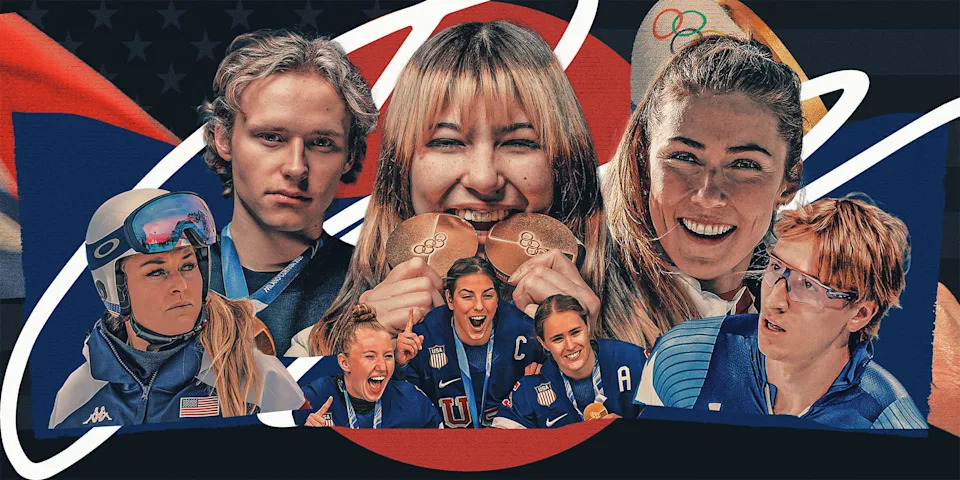
Over the course of 19 days in February, the 2026 Winter Olympic covered more ground than the 11-hour drive from Milan to Cortina to Livigno/Bormio — the three main clusters of these Games. It started with a ski jumping scandal that involved, of all things, the crotch. Ended with an epic hockey game between two bitter rivals. Sandwiched in between was the golden glory of an American who’s more famous in Europe than in his hometown in Wisconsin and the sheer guts and determination of an American icon who simply went for it.
Here is the winding path taken during these Olympic Games:

(Hassan Ahmad/Yahoo Sports illustration)
From Jeff Eisenberg:
Advertisement
MILAN — Male ski jumpers must wear tight-fitting suits that are no more than 4 centimeters larger than their body measurements at any point. Most national teams seek to find every millimeter they can because a bigger, baggier suit catches more wind and provides more lift during flight than a smaller one does.
Fittingly, the most advantageous place to enlarge a ski jumper’s suit is the crotch area.
It’s a story you have to read to believe.
Once the Games began, all eyes quickly turned to Cortina, where Lindsey Vonn was attempting to win a gold medal on a busted ACL she’d torn just a week earlier. She managed both training runs in the downhill without incident, and actually appeared strong. But then …

Lindsey Vonn crashes during the women’s downhill. (Screengrab by IOC via Getty Images)
(Handout via Getty Images)
From Dan Wolken:
Advertisement
LIVIGNO, Italy — It was devastating to watch, even more brutal to hear.
For a nation that had become enraptured in Lindsey Vonn’s comeback story and the norm-defying attempt to win an Olympic medal without an ACL in her left knee, the helpless cries of pain as she lay on her back and as the mountain fell silent will be hard to erase from memory.
Downhill skiing is often breathtaking. It is sometimes gruesome. And for the second time in nine days, the images of an American sports heroine being strapped to a board and lifted into a helicopter churned the stomach.
But that’s skiing down a mountain at 80 miles per hour. That’s the risk Vonn signed up for when she decided to compete in an Olympics nine days after an ACL tear during a different competition in Switzerland. That’s what happens sometimes when you go for it.
Advertisement
And that’s exactly what Vonn did.
While Vonn’s daily health updates from surgery after surgery and her eventual return to the United States captured everyone’s attention, so did Jordan Stolz, a celebrity in Europe but a virtual unknown in America until …

Jordan Stolz celebrates after winning the men’s 1000 meters, his first gold of the 2026 Olympics. (Robert Gauthier / Los Angeles Times via Getty Images)
(Robert Gauthier via Getty Images)
From Jeff Eisenberg:
MILAN — Since rocketing onto the global speedskating scene three years ago, Jordan Stolz — called the next Eric Heiden by none other than Eric Heiden — has become the rare athlete more famous internationally than in his home country. The 21-year-old is a superstar in speedskating hotspots like the Netherlands, Norway and Germany, but he remains almost completely unknown across America and even in his home state of Wisconsin.
Advertisement
Stolz took a big step toward changing that Wednesday night in Milan when he shined in the first of his four races on the Olympic stage. The kid who learned to skate on his family’s backyard pond in Kewaskum, Wisconsin, outraced a world-class field in the men’s 1,000 meters to win his first Olympic gold medal.
Stolz wasn’t done.
But while Stolz lived up to the pre-Olympics hype, even if claiming silver in the 1500 left him feeling these Olympics were only a “partial success”, Ilia Malinin felt the pressure, and it got to him.

Ilia Malinin reacts after competing in the men’s singles free program. (James Lang-Imagn Images)
(IMAGN IMAGES via Reuters Connect / Reuters)
From Jay Busbee:
MILAN — Something was wrong from the very start. Something about Ilia Malinin’s free skate Friday seemed tentative, uncertain, so very unlike the “Quad God.” This was his gold-medal moment, and it was slipping away from him.
Advertisement
He landed his first element, a quad flip, but it had the feel of an unexpected success, like a half-court heave that went through the net, rather than the start of a triumphal procession. And then he skated toward his planned quad axel, a move literally only he can land, a move that could have put him on a direct path to the top of the podium.
He flinched … and was lost.
In one of the most stunning collapses in Olympic figure skating history, Malinin plummeted from a near-certain gold medal all the way to eighth place.
Malinin wasn’t the only American feeling the pressure. Maybe nobody was under more than Mikaela Shiffrin, the most accomplished World Cup skier of all-time but one who has struggled on the Olympic stage. Early in the Games, she let slip a lead in the women’s team ski event, one staked to her by Breezy Johnson, the gold medalist in the downhill. After going medal-less four years ago in Beijing, the doubts started to creep in. And then …

Mikaela Shiffrin celebrartes winning the women’s slalom. (Fei Maohua/Xinhua via Getty Images)
(Xinhua News Agency via Getty Images)
From Jay Busbee:
Advertisement
MILAN — One of the cruel ironies about the Olympics is that it’s better to be a one-and-done medalist than a win-a-few, lose-a-bunch multi-time Olympian. Beijing blanked Mikaela Shiffrin; she didn’t even finish three of the events she entered. Milan Cortina was a bit kinder — she at least made it down the mountain in her earlier events, though at underwhelming-for-her speeds.
With every event that passed without hardware, though, the muttering grew louder. Was Shiffrin spooked by the Olympics? Cursed? How could the most decorated World Cup skier in history dominate everywhere else on the calendar except these two weeks every four years?
So that’s why Wednesday’s race was so critical for Shiffrin. Imagine if she’d fallen short yet again. Imagine if her pole had broken, or if she’d caught that first gate, or suffered any of the other hundred woes that would have kept her off the podium. Imagine the questions that would have followed her, the media second-guessing, the social-media garbage, the internal anxieties that would have wracked her for another four years, and maybe for forever.
«There will always be criticism, but I was here to earn the moment and that is going to require some risk,” she said. “Risk of not finishing. It’s also risk of being criticized, and to accept that. (It is) not the easiest thing to do, but in the end today we were able to do that.»
Advertisement
She stared that grim future in the face … and she flat-out skied right through it.
A little more than 24 hours later, these Olympic Games hit maxim overdrive when, simultaneously, the women of USA and Canada squared off on the ice for gold, while Alysa Liu tried to become the first American women to medal in figure skating in 20 years …

Gold medalist Alysa Liu celebrates on the podium during the medal ceremony for the women’s single skating. (Tang Xinyu/VCG via Getty Images)
(VCG via Getty Images)
From Jay Busbee:
MILAN — As she skated around the Assago Ice Skating Arena rink, moments before the most important routine of her life, Alysa Liu caught sight of her teammate Amber Glenn near the kiss-and-cry couch. Glenn, devastated after Tuesday night’s program, had skated a spectacular routine of her own nearly two hours before. As Liu drew close, she gave Glenn a congratulatory thumbs-up.
Advertisement
“What are you doing?” an exasperated Glenn replied. “Go skate!”
So Alysa Liu did. And she won herself a gold medal, smiling all the way.
There are no record books to measure such things, but it’s entirely possible that no Olympian has ever smiled as much as Liu did on Thursday night, executing a brilliant, virtually flawless free skate that vaulted her from third place into first. She smiled when she stepped onto the ice, she smiled when she spotted Glenn, she smiled through her lutzes and loops and salchows, she smiled when she pointed her left finger to the sky to close out her routine. And she smiled — and giggled a triumphant laugh — when she skated right up to the rinkside camera and bellowed, “That’s what I’m f***ing talking about!”
That is the entire breadth of the Alysa Liu experience — giddiness, confidence, joy, serenity — and gold-medal-winning talent. At an Olympics where so many others have crumbled under the pressure, she literally laughed in pressure’s face.
Advertisement
And then …

Megan Keller celebrates after scoring the game-winning goal in overtime as Claire Thompson of Team Canada reacts during the women’s gold medal game. (Photo by Bruce Bennett/Getty Images)
(Bruce Bennett via Getty Images)
From Jeff Eisenberg:
MILAN — Hilary Knight felt the responsibility to speak up.
The previously unbeaten, unchallenged U.S. women’s hockey team was facing real game pressure for the first time at these Olympics, down a goal and running low on time with just one period left in Thursday’s gold-medal match.
“Who’s going to be the hero?” the 36-year-old American captain said. “We need a hero. There’s a hero in this room.”
Turns out Knight was wrong about one thing . There wasn’t one hero in the U.S. locker room. There was two.
The U.S. doesn’t take gold and glory without Knight giving her team new life with a tying goal with just over two minutes left in regulation, nor without Megan Keller juking a Canadian defender out of her skates to set up the winning goal four minutes into overtime. Those are the plays that made possible a 2-1 gold-medal-clinching, come-from-behind U.S. win. Those are the plays that will live on in U.S. women’s hockey lore long after the American victory celebration comes to an end.
Advertisement
Outside of Liu and, no American-born female individual athlete generated more attention than Eileen Gu … who doesn’t compete for the United States. She skis for China, which has many wondering: Why?

Eileen Gu, born in San Francisco, decided as a 15-year-old that she would compete in the Olympics for China, where her mother was born. (Photo by Wang Peng/Xinhua via Getty Images)
(Xinhua News Agency via Getty Images)
From Dan Wolken:
The answers that many of you seem to want? Sorry, but they’re not coming — certainly not in a press conference room in the Italian Alps after jumping off a 15-story ramp. They’ll probably never come.
Did she cut a deal with the CCP to keep her American passport, in defiance of Chinese law that does not allow for dual citizenship?
Did the $6.6 million she and another American-born athlete earned from the Beijing Municipal Sports Bureau last year — an amount that was accidentally disclosed on a fiscal report before it was scrubbed from the Internet, according to the Wall Street Journal — come with unsavory strings attached?
Advertisement
Does she really believe that inspiring Chinese women to participate in winter sports will make women’s lives better under a regime that is embarrassingly far behind most of the modern world in terms of political representation, economic opportunity and rights for domestic abuse victims?
She’s been asked about all these things, many times over many years in many different venues. And as good as she is on the slopes, she’s even better at Never Going There.
… Here’s the truth: Gu may wear the Five-star Red Flag on her ski suit, but the only entity she truly represents is Eileen Gu, Inc. To present her as anything more than that to fuel American political outrage on social media represents something almost as obnoxious as she is.
But if Eileen Gu is, indeed, all about Eileen Gu, the final gold-medal winners of this Olympics were all about team, and in particular, one member of the team that couldn’t be in Milan.

After winning gold, Team USA made sure to honor the late Johnny Gaudreau. (Photo by Peter Kneffel/picture alliance via Getty Images)
(picture alliance via Getty Images)
From Jay Busbee:
Advertisement
MILAN — They gathered on the ice, two dozen of the best hockey players the United States has ever produced, all of them with wide smiles on their faces and gold medals around their necks having just beaten Canada 2-1 in an overtime thriller. They carried the American flag with them, but they carried something else, too: a Team USA jersey emblazoned with the No. 13 on the back, the name of Johnny Gaudreau embroidered along the shoulders.
It felt good to have a jersey for Gaudreau, who died in a shocking traffic accident 18 months ago, out there in the team’s finest moment. But it didn’t feel quite right.
And then Matthew Tkachuk and Zach Werenski went to the stands and hoisted up Gaudreau’s two oldest children, Noa and Johnny Jr., and brought them out onto the ice. In that perfect moment, all of American hockey smiled through tears.
“To have Johnny and Noa out there,” Dylan Larkin said afterward, “it just felt right.”
Now, it’s on to Los Angeles.